Showing posts with label schools. Show all posts

Thursday, July 20, 2017

Parents vs. Schools Regarding Required Summer Reading: Both Miss the Point

My eighth grade daughter has "recommended" summer reading activities. 

She is expected to come up with three goals, write out a plan as to how she is going to accomplish them, and fill out a chart of her "summer learning activities" (this requires an "Authorized Signature", which I assume means me??, and a spot on the grid to write how it made her Grow).

There is also a suggested reading list with books selected from the Association for Library Service to Children (ALSC)’s 2017 Summer Reading List for Grades 6-8. I haven't heard of any of them, and I'm pretty sure my daughter hasn't either. None of them exactly pique my interest, and I'm a voracious reader (I should note that this particular daughter is not, although you can see from the pic below that she once enjoyed books)

Image may contain: one or more people, people sitting, child and indoor

There is also a link to a lesson plan that teachers were apparently supposed to go over with students at the end of the school year. According to my daughter, this did not happen, and the message she got from her teacher was not to waste her time because nobody cares anyway. Part of me wants to applaud her teacher for her honesty with her students regarding this.

The whole thing is asinine, in my opinion as both a parent and a certified English teacher.

And, as you can imagine, some people in my city are going wild on the issue. Largely on Facebook, of course, but this is probably where you'll get the most honest feedback.

Some samples (All SIC):
* "I don't agree with [mandatory reading over the summer] at all. Both my boys are working full time and involved with family activities. They work hard in school all year and this is the time for them to just be kids. I'm not going to spend my summer forcing my boys to read. It's time to relax and recoup. It is not a time for more school-related pressures."

* "Most kids were burned out of reading after the reading challenge in elementary school making them read makes them despise it."

* "Between football starting next week--ugh--working, visiting family, and dare I say it, just being a kid, there leaves little time to get all this done. It's too much."

* "I think summer vacation means vacation away from school. If you had a vacation off from work and they asked you to do something over that time period you'd think twice about it. J/S."

There are many, many more, but that probably makes the point. And, to be completely fair, there are lots of intelligent, invested parents rebutting these kinds of statements.

Like me, they seem to focus on the idea that kids should be reading *something* in the summer, not just a book from an arbitrary list. Like me, many are appalled that some see reading as such little value. Like me, the idea that having to find time for reading is troubling bothers them.

Children should NOT stop learning because it is summer vacation. My daughter has learned, to give a small sampling, how to put up a pool and monitor chemicals, how to cook a meal, how to hike, how to teach her little sisters to swim, how to beat Super Mario Brothers, how to zipline, how to do different types of French braids, how to survive her first sleepaway camp, how to play the ukelele, how to master gymnastics skills she's been practicing ...


She has also been reading, albeit reluctantly.

She reads a graphic novel series that her father buys one of each month for her. She's reading Thirteen Reasons Why because she was interested in the difference between the book and the Netflix series and whether the story was helpful or harmful to teens (we are both English teachers, so she's heard lots of conversation on that topic) and wanted to be educated enough to weigh in.

She is currently at sleepaway camp (I miss her so much ...), but when she gets back, we are going to require structured reading time. We are going to know what she is reading and discuss it with her. We are going to recommend books to her and read them along with her. She will not love this, of course, because she is not a natural reader, but she will go along because she understands that reading, that learning, is important.

I am not going to require her to fill out those forms but instead keep a log of what she's read and a sentence or two of reflection.

I am going to encourage her to continue swimming, hiking, hanging out with friends, playing with her little sisters, going to Canobie Lake, and whatever else allows her to be a normal thirteen-year-old in 2017.

We made a decision a few weeks ago to cut off her iPad and wireless access on her phone at 10:00 pm. She's certainly gotten more sleep, which has also made a difference.

We are also going to make an effort to go to more museums, historical sites, and that sort of thing.

That is what learning is about ... and learning should happen in the summer. Reading must happen in the summer if we want to keep our children's reading fluency and knowledge base where it needs to be.

Should the school set out a canned summer  learning recommendation list for all students without taking into account what happens at home? No. Families that value summer learning have, with all due respect, long since put things into place that are far more meaningful than what's been offered.

Families that do not value summer learning need more than a bunch of printouts (and poor printouts, at that). They need to be educated on how to turn experiences into learning, which is far more valuable than how to break down a goal into parts. They need support and explanations and suggestions for how to make learning an integral part of every day.

Am I way off base with my frustration here?  

Monday, September 14, 2015

Equalizing Education? Not with This Obstacle ...

While the United States provides public education to its population, the quality of such is all over the map. It's simply unavoidable.

There are many and varied reasons for this, of course.

School districts that pay their teachers and administrators well are likely to retain a strong, talented staff of educators. The converse, of course, is also true.

Larger schools have a larger pool to pull from in terms of athletic teams, extracurriculars, and students to fill in Advanced Placement classes.

Smaller schools often provide a family feel, where students and staff know each other well and would go to the mat for each other. 

Inner city schools are frequently rich in culture and diversity.

Consolidated country schools offer original electives such as cow care and snowmobile mechanics.

Whether we are using "Common Core", sold as the great educational equalizer intended to level the playing field, or not, there is no question that schools are vastly different. I live in New Hampshire, and my children have gone to three different school districts. Extremely different.

Are all New England Schools alike? Of course not. The South? Runs the gamut, I'm sure. California? The so-called Bible Belt? Alaska or Hawaii? 

It's hard enough to compare schools in one state or one region, but let's be real; no two schools are alike. I've been an educator long enough to know that each and every school has both significant strengths and weaknesses.

There is--I'm just going to say this--no way to uniformly educate the children of America. Geography, finances, quality of teaching staff, and so on ... it's just not possible to enforce uniformity.

And that's okay ... because the biggest obstacle facing American children in 2015 is none of those things.

Nope, my theory is that the detriment to American schoolchildren is their families.

Wait, their families? Not the Common Core? Not teachers on strike? Not shoddy materials? Not shabby facilities?

That's right. Their families.   

I learned early on that, when I asked my eldest daughter, Emily, how school was, the inevitable answer was, "Fine." It took me a few years, but I eventually learned to ask direct questions. What was on the history quiz? Are you enjoying Of Mice and Men? What music are you playing in band? It was harder for her to give monosyllabic responses to that.

And then Ari came along, and she couldn't talk about school enough. Well, let me rephrase that ... Ari couldn't talk enough about the social aspects of school. The kid should have written an elementary school gossip magazine. However, I'd learned from her stoic sister that specific questions led to discussion, so I ended up hearing all about her classes as well.

Yup, it was pulling teeth to get any sort of curriculum conversations going with either of them, excellent students both ... and I'm a teacher.

I wonder sometimes how many parents want desperately to talk about school with their kids, to analyze Steinbeck and conjugate Latin verbs and weigh the pros and cons of the Vietnam conflict. I suspect the number is large, even for those that never have said conversations. Children can be tough nuts to crack, and if school is their private world they might well want to keep Mom and Dad out of it.

I persist, though, and I think a lot of parents do as well. I have a fairly good idea of what's going on with each of them, even though Emily is in college now (hating her astronomy class, disappointed in her language acquisition course, and learning lots in history of the English language) and Ari is a middle schooler (exponents in math, warning sign identification in science, the story behind their first name in Language Arts).

It would be really easy for me to say, "I'm an involved parent. I talk to my kids about school, even digging for details. I check their homework. They ask me for help when needed. I am so involved it's not even funny." 

Except that's not precisely true.

Personally, I hate big crowds of people I mostly don't know. Going to open houses and festivals and concerts and such bring on anxiety attacks. I know Ari would like it if I volunteered at her school (if I had the free time) or took her to middle school football games or encouraged her to have friends over. Sometimes I can even handle this, but much of the time, I can't. 

Also, I could stalk the online grade program and/or e-mail her teachers all the time, but I don't want to be a pain.

Overall, though, parental involvement should not be a concern for me, right?

Wrong again.

Parental involvement is a problem for everybody!

The biggest problem shared with me by both Emily and Ari is one and the same: the other kids act like monsters and keep the teacher from being as effective as he or she would otherwise be.

You might say, the teacher should send the kid to the office. The teacher should call home. The kid should be punished. This shouldn't be allowed.

Sadly, these kids have missed out on a lot of learning when they languished in the office. Phone calls home run from, "Well, he says you have it in for him!" or "Everyone else was throwing spitballs, too" to, "That's a school problem. I have a hard enough time dealing with him at home." 

Because those parents enable, make excuses for, or give up on their children, my children miss out. 

Is that fair to my children? No ... but yes. You see, my children have had to learn to extend their education on their own. Instead of being one of those obnoxious and overbearing parents that call teachers the second week of school and say, "My child is bored", I strive to teach my kids to read more, to list questions about topics in history class that we can discuss as a family later, to write in a journal. My children are bright and successful, but I would never extol them as special snowflakes.


Parental involvement is a multi-faceted thing. It's not just talking to kids about school. It's not just having sports dates and days off written on the calendar. It's not just going on teacher websites. It's not going to school events, whether you want to or not.

It's all of those things, and it's more.

As a parent, I raise my children fully aware that their teachers are playing a role in their upbringing as well. As a teacher, I buy everything from lunch to deodorant to tampons to notebooks to sneakers for my students. I teach them English, but I also teach them manners and respect.

But it's an uphill battle.

Until parents are unified in their view of what education means for American children in 2015, the problem will exist. In fact, it will get worse. Parents work long hours. They are too tired to attend school events. They might not have transportation, and it's increasingly common for parents uncomfortable with speaking English to avoid going into schools out of fear and discomfort. Kids are seduced by drugs and gangs and horribly short skirts from American Eagle. 

The only way for education to be equalized is for parents to become fully invested in their children's schooling. Only then can we all work together to provide a high quality, equal education to every student. 

Friday, February 17, 2012

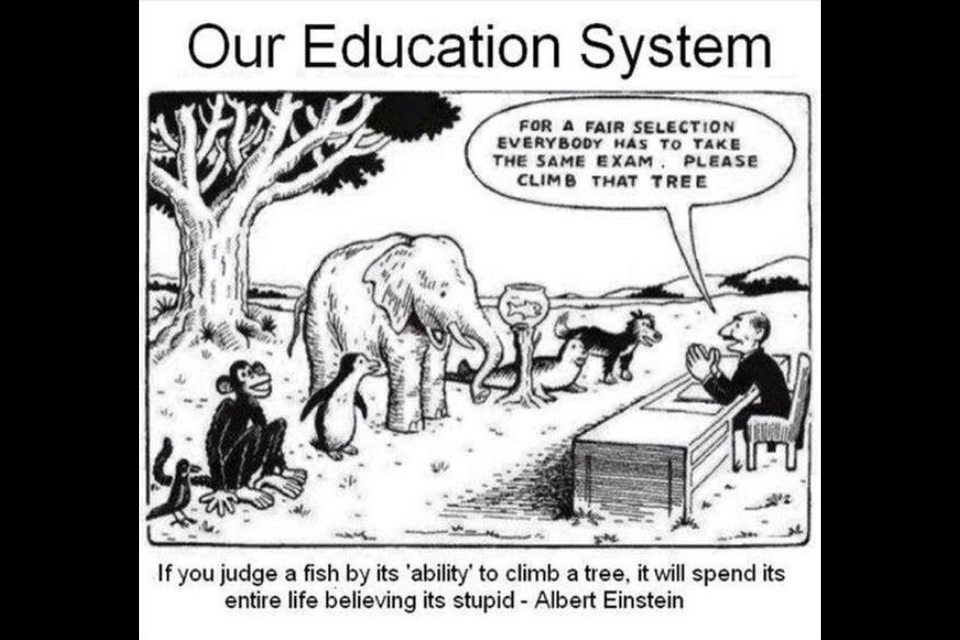
The Education Conundrum--How to Teach Every Kid?

Yes, I'm still out of work ... one more day, according to my recheck yesterday with my primary care doctor.  I'm resting on the couch with my computer (I seem to be okay until I get up and start moving around, so I guess this counts as resting, which is the big word in my recovery ... I mentioned that I'm a failure at resting, right?).

Anyway, I got talking to some friends in the education world (many of my friends are teachers, which I suppose is only natural), and we got talking a lot about the education conundrum--namely, how to teach every student (I will not insult anyone's intelligence or fan flames of government distrust by using the words "no child left behind").

Schools are in different places.  VASTLY different places.  I have to say that, if nothing else, I was pleased to learn how truly cutting edge my school is in a lot of ways.

Anyway, I view education through three lenses--as a former student myself, as a parent, and as a teacher.

My hope with this post is to generate conversation.  Nothing would make me happier than for the comments to fill up, for people to share their thoughts and experiences, and for all of us to do a little thinking, a little learning, a little growing.

And, okay, I want to write a professional article on the state of education today for a national ed journal (I actually have a Master's Degree in education along with a B.A. in English ... I just play dumb sometimes ;-)).

Just to get a little bit of jargon out of the way, I want to give you two words which have significantly impacted my own philosophy of education: Personalized Instruction.

Basically, this is the notion that every effort should be made to make learning accessible to all students.  Obviously, writing a separate curriculum for every single student is patently impossible, but allowing students some voice and choice, trying to make learning interesting and relevant to all students, considering that there are many different ways to demonstrate knowledge ... yeah, it's hard to explain (and also VERY hard to do), but hopefully that makes some sense.

KLO AS A STUDENT
I learned how to read when I was a toddler.  While it sounds impressive, it was actually a huge detriment to the basic foundations of my education.

Why?  Because, while I learned early on how to delve into literature, to lose myself into the magic of a story, I never learned how to read strategically.  If I had no interest in reading something, I wouldn't.  If I was assigned a chapter in a science textbook or a history article or something, I simply couldn't force myself to do it.  I had no skills for how to read something that was difficult for me, and I never learned how to do that until I was a teacher myself.

Between the precocious reading and strong skills in writing I demonstrated at a very early age, I managed to write my way into correct answers for most of my school years.

And math?  Yeah, let's not even go there.  To this day, I cannot add two digit numbers in my head, never mind multiply, divide, or subtract.  I was too busy reading--and reading what I wanted to read, at that.

Because of the way tracking was done at my school, however, I could not take Honors English and Pre-Algebra.  I had to make a choice, and so I ended up in Algebra I with no preparation at all.  Math, which had always been hard for me, became a nightmare--I walked into Algebra I thinking that "X" meant multiply, and it only got worse.

I carried the "laziness" burden around with me for most of my school career.  When I was a high school junior, I finally convinced my mother that I really was trying, and I got evaluated, tested, and diagnosed with two learning disabilities, one in auditory processing ("in one ear and out the other" was the story of my life) and one in spatial awareness (explains why math is such a struggle).

I also learned, as an adult, that I have ADHD, which retrospectively explains why I long struggled with focusing, with completing tasks, with making good choices, and with basically sitting down and shutting up when told.

If my teachers had been trained in personalized instruction, in student-centered learning, school would almost certainly have been a more positive experience for me.    

KLO AS A PARENT
Like all parents, I want my kids to get a good education, to learn lots, and to be successful in school (as measured by things other than report cards and test scores).

Addie is a senior now, and she has always been tracked into high classes.  She's in her second A.P. English class this year, and she just started French V.  .

Addie is extremely bright, but she's also a very lazy student.  She knows how to get by; she learned early and well how to play the game, how to jump through the right hoops.  She's always gotten good grades, but I wonder sometimes how much she's really learned.

The SAT experience was a perfect example of this.  She took the SATs, did slightly above average but not good enough for the schools to which she's applying, so she did a bunch of prep-work, figured out how to raise her scores, and received exceptional numbers when she retook it.

She is also--and I know she'll read this and probably freak out, but it's God's honest truth--an academic snob.  When she is taken out of her Advanced Placement ivory tower, she gets very frustrated with her less book-smart classmates.  The superiority complex she's developed as being one of the "smart kids" has not prepared her for the real world, nor has it given her the skills to teach herself when the going gets tough (as it inevitably will when she starts college).      

Addie's education has been largely what I refer to as "old school"--ability grouping, lots of paper and pencil tests, little opportunity for collaboration with peers, and so on.  I'm pleased with the education she's received (and I'll be proud as heck at graduation that she's going to be among the "chosen ones" wearing the National Honor Society cord), but I'm also aware of its limitations.

Belle's school approaches education very differently.  It's all collaboration, groupwork, projects that might or might not be reflective of a child's efforts (you can read my rant on a recent situation here, if you so desire), and so on.

Belle, who is also a very bright kid, takes great pride in helping out classmates that struggle.  I'm pretty sure she's more computer-literate than I am.  She loves conferencing with her teacher about everything from her writing to the books she's reading.

At Belle's parent/teacher conference a couple of months ago, I got the unmistakable impression that her teacher knows Belle as a learner, is well aware of her strengths and challenge areas.  I have no doubt whatsoever that her teacher (who is absolutely outstanding, by the way) personalizes instruction for Belle and her classmates.  

That being said, I worry that Belle is, at some point, going to hit a wall as well.  As the gaps between "the smart kids" and those that struggle widens, the personalization piece becomes increasingly challenging.

Is it fair to expect Belle to "self-teach" while the teacher focuses on skills she's mastered with the rest of the class? Should Belle have to do the lion's share of the work in group projects?  Is there going to come a point in time when she, like Addie, realizes that it's all about jumping through the right hoops at the right time?

Unlike Addie, Belle is a child absolutely driven by intellectual curiosity, so I'm hoping that she'll manage to avoid those pitfalls.

KLO AS A TEACHER
Personalized instruction has become extremely important to me as a teacher.  Like, it's the driving force of my personal philosophy of pedagogy these days.

I know my students.  I know them very well, their strengths and their challenge areas.  I know the specific ways to motivate each kid (sometimes it's positive reinforcement, sometimes it's the iron fist, sometimes it's calling home, sometimes it's bribery with doughnuts, and so on).  I know what each student is capable of, and I know how to help them set realistic goals for improving their reading and writing skills.

I know which kids freeze up during paper and pencil tests, and I know enough to go over failed assessments orally with them so they can demonstrate that they do in fact know the material being assessed.  I know that, if a student is missing an assignment, I can get him or her to make it up pretty quickly by staying after school with me or eating lunch in my classroom.  I know that, even though my students make fun of me for being lame when I make a big deal over them understanding complex literature, it invokes a sense of pride in them.

It's actually not as impressive as it sounds; I work in an extremely small school, and we are fortunate enough to have very wise district-level administration that arranges for consultants to be brought in to train teachers based on specific need (kind of like personalizing instruction for teachers ... genius, really).  The district admin is also quite gifted in grantwriting, which makes a lot of things possible that wouldn't be otherwise.

The friend that was most frustrated during our recent conversation works in a huge school.  HUGE.  He was distraught because a high percentage of his kids failed the first quiz on a play they are reading aloud as a class.  Each student had a study guide, encouragement to take notes during class discussions, and plenty of opportunity to ask for clarification knowing that an assessment was forthcoming.

"I don't know what else I can do!" he lamented. (there might have been a F-bomb or two thrown in there as well ...)

I probably didn't help much.

I suggested the idea of differentiated assessment (in other words, giving kids a choice of how they want to be assessed on the material).

It's actually not as loosy-goosy as it sounds; if your performance assessments are rigorous, which they should always be, and they are measuring the same thing as a traditional quiz, does it really matter how the students demonstrate the knowledge?

My friend was assessing whether students could identify the characters and major plot points from the first section of a work of literature.  The assessment was matching, fill-in-the-blank, and multiple choice for quotation identification.  While students are given the option to re-take the quiz if they fail, their potential grade caps out at a 70 for a restest.

The reason for this, as texted to me by my friend this morning?
The cap is a result of A.P. parents bitching to the school board about how unfair it is to their kids that someone with "more time" can get the same [grade] as their child, who "did it on time".
As the parent of an A.P. student, I find this appalling.  If I want Addie to be challenged--and I do--then it would be my (and, presumably, her teacher's) expectation that she be held to a different (and definitely higher) standard than a kid that can't read.  That seems like a no-brainer to me.  

According to my friend, every student (not just in his particular section of the class but those taught by other teachers as well ... huge school, remember?) is supposed to do the same assessment for an agreed-upon work of literature.  The same paper and pencil, boring as heck assessment.
The attitude is that standardized tests aren't done that way, so we're not helping them if we don't give uniform assessments.  "Students need to learn to take ALL forms of assessment" is the attitude of the consultant who makes policy.
I gave a recent assignment to my students where they had to write a letter to Romeo or Juliet from the point of view of another character.  The rubric was very specific and, in my opinion, very rigorous.  They had to identify and describe at least three plot points from Act I, they  had to demonstrate their knowledge of a character by taking on his or her persona, and they had to make a judgment as the character on their impressions of Romeo and Juliet's first meeting.

I could have given them a multiple choice test.  I could have said, "Write a summary of Act I".  It accomplished the same objective, after all; I mean, I could tell by the letters if my kiddos understood the play so far.

You know what?  They had a freaking ball writing those letters.  A large number of kids challenged themselves (with absolutely no prompting from me, I might add) by attempting to write their letters in Shakespearean language.  One of them, writing as Mercutio, talked about being very busy with his "interest in Indian opiates" after referencing Mercutio's vision of Queen Mab.

Kids who would have flat out refused to write a standard summary, who would have randomly picked letters on a multiple choice quiz, became engaged in this assignment beyond my wildest dreams.

Now, please don't get the impression that I think I'm the world's greatest teacher.  I'm definitely not.  I have lessons flop all the time, although since I've received training in inquiry-based learning, in increasing student engagement, in allowing students a degree of choice in what they are doing, in looking at bottom line objectives tied to curriculum standards instead of hoping that they'll circle the right multiple choice letter, it happens a lot less often.

So why is the idea of at least exploring this sort of student-centered instruction and assessment so abhorrent to some schools?  According to my friend, it comes down to three letters--SAT.  I'm guessing "NECAP" is in there as well (that's the state standardized test that decides whether or not a school is "failing").
The major problem in this district is that the entire system is built on the idea that every kid should be on a path to college.  Therefore, every kid must be able to do well on the SAT, and therefore they must be able to do that sort of test.
I think it's an even deeper problem than that, though.  I'm totally convinced that half the reason students flub the SAT is that they have never been engaged in school, they have experienced little to no success in school, and so they walk in expecting to bomb the SAT ... and we all know how powerful self-fulfilling prophesies are.

Will a student suddenly do a 180 because he or she experiences success by summarizing the first part of a work of literature in an unorthodox way and subsequently blow the SAT out of the water?  No.  Of course not.

But if students can experience success at school, if they--dare I say it--actually push themselves to go above and beyond merely identifying plot points on a multiple choice test because the assignment is *gasp* kind of fun, I don't see how that can be seen  as anything but positive!

And there is no doubt that, in this day of standardized testing as the be all/end all, we have a responsibility to teach students how to take a test.  It only stands to reason, though, that the likelihood of those "test-taking lessons" going over well increases exponentially when you're dealing with students with some degree of school buy-in.

And that's not going to happen if all they have to look forward to are circling letters (and, just in case anyone's wondering, "B" has been proven to be the most common multiple choice answer ... when in doubt, go with "B").

Please share your thoughts on this very serious crisis in America ... I like to think, learn, and grow as much as anyone :-)

Monday, August 9, 2010

Teacher Questionnaire (Yes, I Took it Seriously ... Mostly)

My school has a new principal starting this fall, and he recently mailed out a questionnaire for all teachers to fill out so he could get to know the teachers and staff. I thought this was a really neat idea, actually, so I did it right away (because I'm just that on top of things ;))

It occurred to me that, while I write a lot about thinking and family and writing and that sort of thing here, I tend to keep my life as a teacher a bit more distant. Here is a glimpse at the "teacher-me".

And just to be clear, I've changed the name of my school and the other districts I've worked at. After all, a workplace deserves a pseudonym, too.

Ahem ...

Why I am here:
I became a teacher because I love showing students how to look at the world in a big-picture kind of way. If kids are able to make connections between their own lives and, say, Shakespeare’s Romeo and Juliet, I feel like I have been successful. It’s often a great challenge for students to see how virtually everything connects, that the greater the body of knowledge and thinking strategies you can amass the better off you are, but it is incredibly rewarding.

How did I get here?
Growing up, I was the one who wrote plays and organized productions featuring all of the neighborhood kids. Starting when I was in second grade, I was asked to go read to the special education class twice a week, an event I looked forward to greatly and continued doing throughout elementary school. I started babysitting at a young age and continued doing it even after I got slightly more lucrative jobs such as lifeguarding at Water Country and running birthday parties at Chuck E. Cheese’s. This is my ninth year teaching; I spent two years in the JONES (lol) School District at the middle school level and four years in the SMITH (haha) School District. However, my two years at DOE HIGH SCHOOL have unquestionably been the most fulfilling of my career.

My education and certifications are:
B.A. in English (cum laude)from the University of New Hampshire and M.Ed. (Secondary English Education with a Reading Concentration) also from UNH. My teaching certification is Secondary English (Grades 5-12, and yes, I passed the Praxis II) although my coursework and trainings also evidently qualify me for alternative certifications ranging from Reading Specialist, Special Educator, ESOL, and some sort of computer teacher certification.

What I like most about DOE HIGH SCHOOL:
DOE HIGH SCHOOL is full of decent people, both students and adults. I can’t think of a better word than “decent”, although that seems to fall short. I liken it to my M&M theory … if I was carrying a giant bag of M&Ms down the hall at DOE and dropped it, scattering little pieces of candy everywhere, probably 95% of the school would be running to help pick them all up. This is not true of any other school I’ve worked at or volunteered in nor of any other workplace outside of education I’ve ever experienced (especially Chuck E. Cheese’s ;)).

What I would like to see improved most at DOE HIGH SCHOOL to improve student learning:
There is an unsettling sense of apathy among a large percentage of our students. Many of them do not see the value of education and will quietly and respectfully fail a class or settle for a D-. One of the greatest things I’ve seen happen is students responding to connections made with staff that have allowed faculty to personalize instruction, to put the individual needs of each child into their teaching, and to strive to intentionally create authentic learning experiences that will allow the highest level of student buy-in. I would really like to see all teachers (myself included) work more on knowing who students are, how students learn, and what we can do to ensure that every student will succeed.

Who am I outside of school:
Most importantly, I am the mother of two amazing daughters. Addie, a musician and a scholar, will be a junior at YET ANOTHER HIGH SCHOOL, and Belle, the only kid in America counting down the days until school starts, will be starting first grade. I have a part-time job as a writer for a women’s issues website, which has been a great opportunity to hone my journalism skills as well as to get my name out there (since my ultimate goal is to be a novelist … I’ve written one book and three-quarters of another, although they are sadly unpublished). I like to read and hang out at the beach in the summer (although my surfing days are unfortunately over) and ski in the winter.

Are Minorities Discouraged from Taking Upper-Level Classes?: The Elephant in the Room

As a public school teacher for sixteen years, I sometimes feel like I’ve seen it all. I’ve seen Standards come and go (and despite the brou...