Yes, I'm still out of work ... one more day, according to my recheck yesterday with my primary care doctor. I'm resting on the couch with my computer (I seem to be okay until I get up and start moving around, so I guess this counts as resting, which is the big word in my recovery ... I mentioned that I'm a failure at resting, right?).
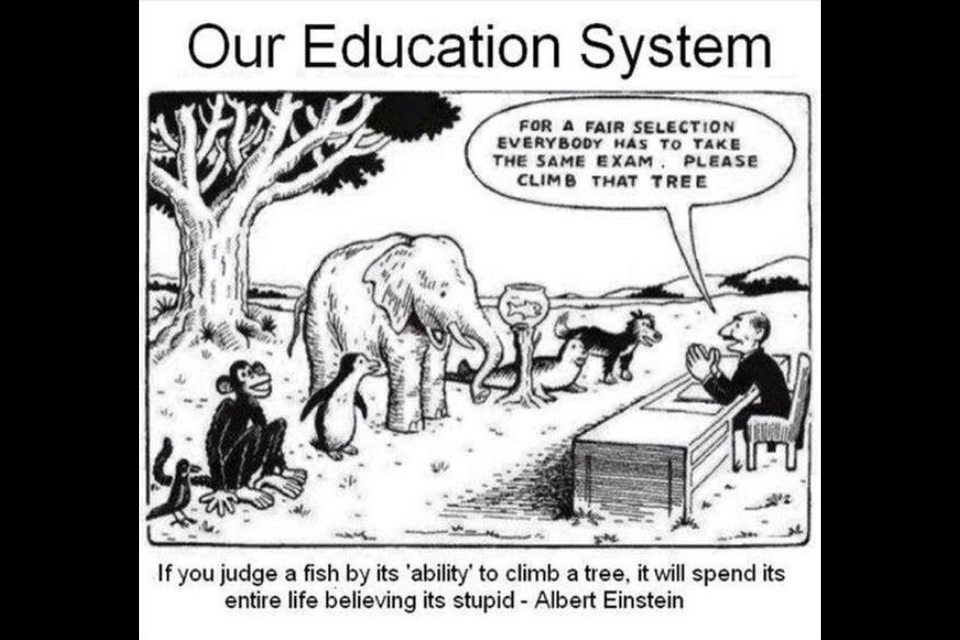
Anyway, I got talking to some friends in the education world (many of my friends are teachers, which I suppose is only natural), and we got talking a lot about the education conundrum--namely, how to teach every student (I will not insult anyone's intelligence or fan flames of government distrust by using the words "no child left behind").
Schools are in different places. VASTLY different places. I have to say that, if nothing else, I was pleased to learn how truly cutting edge my school is in a lot of ways.
Anyway, I view education through three lenses--as a former student myself, as a parent, and as a teacher.
My hope with this post is to generate conversation. Nothing would make me happier than for the comments to fill up, for people to share their thoughts and experiences, and for all of us to do a little thinking, a little learning, a little growing.
And, okay, I want to write a professional article on the state of education today for a national ed journal (I actually have a Master's Degree in education along with a B.A. in English ... I just play dumb sometimes ;-)).
Just to get a little bit of jargon out of the way, I want to give you two words which have significantly impacted my own philosophy of education: Personalized Instruction.
Basically, this is the notion that every effort should be made to make learning accessible to all students. Obviously, writing a separate curriculum for every single student is patently impossible, but allowing students some voice and choice, trying to make learning interesting and relevant to all students, considering that there are many different ways to demonstrate knowledge ... yeah, it's hard to explain (and also VERY hard to do), but hopefully that makes some sense.
KLO AS A STUDENT
I learned how to read when I was a toddler. While it sounds impressive, it was actually a huge detriment to the basic foundations of my education.
Why? Because, while I learned early on how to delve into literature, to lose myself into the magic of a story, I never learned how to read strategically. If I had no interest in reading something, I wouldn't. If I was assigned a chapter in a science textbook or a history article or something, I simply couldn't force myself to do it. I had no skills for how to read something that was difficult for me, and I never learned how to do that until I was a teacher myself.
Between the precocious reading and strong skills in writing I demonstrated at a very early age, I managed to write my way into correct answers for most of my school years.
And math? Yeah, let's not even go there. To this day, I cannot add two digit numbers in my head, never mind multiply, divide, or subtract. I was too busy reading--and reading what I wanted to read, at that.
Because of the way tracking was done at my school, however, I could not take Honors English and Pre-Algebra. I had to make a choice, and so I ended up in Algebra I with no preparation at all. Math, which had always been hard for me, became a nightmare--I walked into Algebra I thinking that "X" meant multiply, and it only got worse.
I carried the "laziness" burden around with me for most of my school career. When I was a high school junior, I finally convinced my mother that I really was trying, and I got evaluated, tested, and diagnosed with two learning disabilities, one in auditory processing ("in one ear and out the other" was the story of my life) and one in spatial awareness (explains why math is such a struggle).
I also learned, as an adult, that I have ADHD, which retrospectively explains why I long struggled with focusing, with completing tasks, with making good choices, and with basically sitting down and shutting up when told.
If my teachers had been trained in personalized instruction, in student-centered learning, school would almost certainly have been a more positive experience for me.
KLO AS A PARENT
Like all parents, I want my kids to get a good education, to learn lots, and to be successful in school (as measured by things other than report cards and test scores).
Addie is a senior now, and she has always been tracked into high classes. She's in her second A.P. English class this year, and she just started French V. .
Addie is extremely bright, but she's also a very lazy student. She knows how to get by; she learned early and well how to play the game, how to jump through the right hoops. She's always gotten good grades, but I wonder sometimes how much she's really learned.
The SAT experience was a perfect example of this. She took the SATs, did slightly above average but not good enough for the schools to which she's applying, so she did a bunch of prep-work, figured out how to raise her scores, and received exceptional numbers when she retook it.
She is also--and I know she'll read this and probably freak out, but it's God's honest truth--an academic snob. When she is taken out of her Advanced Placement ivory tower, she gets very frustrated with her less book-smart classmates. The superiority complex she's developed as being one of the "smart kids" has not prepared her for the real world, nor has it given her the skills to teach herself when the going gets tough (as it inevitably will when she starts college).
Addie's education has been largely what I refer to as "old school"--ability grouping, lots of paper and pencil tests, little opportunity for collaboration with peers, and so on. I'm pleased with the education she's received (and I'll be proud as heck at graduation that she's going to be among the "chosen ones" wearing the National Honor Society cord), but I'm also aware of its limitations.
Belle's school approaches education very differently. It's all collaboration, groupwork, projects that might or might not be reflective of a child's efforts (you can read my rant on a recent situation here, if you so desire), and so on.
Belle, who is also a very bright kid, takes great pride in helping out classmates that struggle. I'm pretty sure she's more computer-literate than I am. She loves conferencing with her teacher about everything from her writing to the books she's reading.
At Belle's parent/teacher conference a couple of months ago, I got the unmistakable impression that her teacher knows Belle as a learner, is well aware of her strengths and challenge areas. I have no doubt whatsoever that her teacher (who is absolutely outstanding, by the way) personalizes instruction for Belle and her classmates.
That being said, I worry that Belle is, at some point, going to hit a wall as well. As the gaps between "the smart kids" and those that struggle widens, the personalization piece becomes increasingly challenging.
Is it fair to expect Belle to "self-teach" while the teacher focuses on skills she's mastered with the rest of the class? Should Belle have to do the lion's share of the work in group projects? Is there going to come a point in time when she, like Addie, realizes that it's all about jumping through the right hoops at the right time?
Unlike Addie, Belle is a child absolutely driven by intellectual curiosity, so I'm hoping that she'll manage to avoid those pitfalls.
KLO AS A TEACHER
Personalized instruction has become extremely important to me as a teacher. Like, it's the driving force of my personal philosophy of pedagogy these days.
I know my students. I know them very well, their strengths and their challenge areas. I know the specific ways to motivate each kid (sometimes it's positive reinforcement, sometimes it's the iron fist, sometimes it's calling home, sometimes it's bribery with doughnuts, and so on). I know what each student is capable of, and I know how to help them set realistic goals for improving their reading and writing skills.
I know which kids freeze up during paper and pencil tests, and I know enough to go over failed assessments orally with them so they can demonstrate that they do in fact know the material being assessed. I know that, if a student is missing an assignment, I can get him or her to make it up pretty quickly by staying after school with me or eating lunch in my classroom. I know that, even though my students make fun of me for being lame when I make a big deal over them understanding complex literature, it invokes a sense of pride in them.
It's actually not as impressive as it sounds; I work in an extremely small school, and we are fortunate enough to have very wise district-level administration that arranges for consultants to be brought in to train teachers based on specific need (kind of like personalizing instruction for teachers ... genius, really). The district admin is also quite gifted in grantwriting, which makes a lot of things possible that wouldn't be otherwise.
The friend that was most frustrated during our recent conversation works in a huge school. HUGE. He was distraught because a high percentage of his kids failed the first quiz on a play they are reading aloud as a class. Each student had a study guide, encouragement to take notes during class discussions, and plenty of opportunity to ask for clarification knowing that an assessment was forthcoming.
"I don't know what else I can do!" he lamented. (there might have been a F-bomb or two thrown in there as well ...)
I probably didn't help much.
I suggested the idea of differentiated assessment (in other words, giving kids a choice of how they want to be assessed on the material).
It's actually not as loosy-goosy as it sounds; if your performance assessments are rigorous, which they should always be, and they are measuring the same thing as a traditional quiz, does it really matter how the students demonstrate the knowledge?
My friend was assessing whether students could identify the characters and major plot points from the first section of a work of literature. The assessment was matching, fill-in-the-blank, and multiple choice for quotation identification. While students are given the option to re-take the quiz if they fail, their potential grade caps out at a 70 for a restest.
The reason for this, as texted to me by my friend this morning?
According to my friend, every student (not just in his particular section of the class but those taught by other teachers as well ... huge school, remember?) is supposed to do the same assessment for an agreed-upon work of literature. The same paper and pencil, boring as heck assessment.
I could have given them a multiple choice test. I could have said, "Write a summary of Act I". It accomplished the same objective, after all; I mean, I could tell by the letters if my kiddos understood the play so far.
You know what? They had a freaking ball writing those letters. A large number of kids challenged themselves (with absolutely no prompting from me, I might add) by attempting to write their letters in Shakespearean language. One of them, writing as Mercutio, talked about being very busy with his "interest in Indian opiates" after referencing Mercutio's vision of Queen Mab.
Kids who would have flat out refused to write a standard summary, who would have randomly picked letters on a multiple choice quiz, became engaged in this assignment beyond my wildest dreams.
Now, please don't get the impression that I think I'm the world's greatest teacher. I'm definitely not. I have lessons flop all the time, although since I've received training in inquiry-based learning, in increasing student engagement, in allowing students a degree of choice in what they are doing, in looking at bottom line objectives tied to curriculum standards instead of hoping that they'll circle the right multiple choice letter, it happens a lot less often.
So why is the idea of at least exploring this sort of student-centered instruction and assessment so abhorrent to some schools? According to my friend, it comes down to three letters--SAT. I'm guessing "NECAP" is in there as well (that's the state standardized test that decides whether or not a school is "failing").
Will a student suddenly do a 180 because he or she experiences success by summarizing the first part of a work of literature in an unorthodox way and subsequently blow the SAT out of the water? No. Of course not.
But if students can experience success at school, if they--dare I say it--actually push themselves to go above and beyond merely identifying plot points on a multiple choice test because the assignment is *gasp* kind of fun, I don't see how that can be seen as anything but positive!
And there is no doubt that, in this day of standardized testing as the be all/end all, we have a responsibility to teach students how to take a test. It only stands to reason, though, that the likelihood of those "test-taking lessons" going over well increases exponentially when you're dealing with students with some degree of school buy-in.
And that's not going to happen if all they have to look forward to are circling letters (and, just in case anyone's wondering, "B" has been proven to be the most common multiple choice answer ... when in doubt, go with "B").
Please share your thoughts on this very serious crisis in America ... I like to think, learn, and grow as much as anyone :-)
Anyway, I got talking to some friends in the education world (many of my friends are teachers, which I suppose is only natural), and we got talking a lot about the education conundrum--namely, how to teach every student (I will not insult anyone's intelligence or fan flames of government distrust by using the words "no child left behind").
Schools are in different places. VASTLY different places. I have to say that, if nothing else, I was pleased to learn how truly cutting edge my school is in a lot of ways.
Anyway, I view education through three lenses--as a former student myself, as a parent, and as a teacher.
My hope with this post is to generate conversation. Nothing would make me happier than for the comments to fill up, for people to share their thoughts and experiences, and for all of us to do a little thinking, a little learning, a little growing.
And, okay, I want to write a professional article on the state of education today for a national ed journal (I actually have a Master's Degree in education along with a B.A. in English ... I just play dumb sometimes ;-)).
Just to get a little bit of jargon out of the way, I want to give you two words which have significantly impacted my own philosophy of education: Personalized Instruction.
Basically, this is the notion that every effort should be made to make learning accessible to all students. Obviously, writing a separate curriculum for every single student is patently impossible, but allowing students some voice and choice, trying to make learning interesting and relevant to all students, considering that there are many different ways to demonstrate knowledge ... yeah, it's hard to explain (and also VERY hard to do), but hopefully that makes some sense.
KLO AS A STUDENT
I learned how to read when I was a toddler. While it sounds impressive, it was actually a huge detriment to the basic foundations of my education.
Why? Because, while I learned early on how to delve into literature, to lose myself into the magic of a story, I never learned how to read strategically. If I had no interest in reading something, I wouldn't. If I was assigned a chapter in a science textbook or a history article or something, I simply couldn't force myself to do it. I had no skills for how to read something that was difficult for me, and I never learned how to do that until I was a teacher myself.
Between the precocious reading and strong skills in writing I demonstrated at a very early age, I managed to write my way into correct answers for most of my school years.
And math? Yeah, let's not even go there. To this day, I cannot add two digit numbers in my head, never mind multiply, divide, or subtract. I was too busy reading--and reading what I wanted to read, at that.
Because of the way tracking was done at my school, however, I could not take Honors English and Pre-Algebra. I had to make a choice, and so I ended up in Algebra I with no preparation at all. Math, which had always been hard for me, became a nightmare--I walked into Algebra I thinking that "X" meant multiply, and it only got worse.
I carried the "laziness" burden around with me for most of my school career. When I was a high school junior, I finally convinced my mother that I really was trying, and I got evaluated, tested, and diagnosed with two learning disabilities, one in auditory processing ("in one ear and out the other" was the story of my life) and one in spatial awareness (explains why math is such a struggle).
I also learned, as an adult, that I have ADHD, which retrospectively explains why I long struggled with focusing, with completing tasks, with making good choices, and with basically sitting down and shutting up when told.
If my teachers had been trained in personalized instruction, in student-centered learning, school would almost certainly have been a more positive experience for me.
KLO AS A PARENT
Like all parents, I want my kids to get a good education, to learn lots, and to be successful in school (as measured by things other than report cards and test scores).
Addie is a senior now, and she has always been tracked into high classes. She's in her second A.P. English class this year, and she just started French V. .
Addie is extremely bright, but she's also a very lazy student. She knows how to get by; she learned early and well how to play the game, how to jump through the right hoops. She's always gotten good grades, but I wonder sometimes how much she's really learned.
The SAT experience was a perfect example of this. She took the SATs, did slightly above average but not good enough for the schools to which she's applying, so she did a bunch of prep-work, figured out how to raise her scores, and received exceptional numbers when she retook it.
She is also--and I know she'll read this and probably freak out, but it's God's honest truth--an academic snob. When she is taken out of her Advanced Placement ivory tower, she gets very frustrated with her less book-smart classmates. The superiority complex she's developed as being one of the "smart kids" has not prepared her for the real world, nor has it given her the skills to teach herself when the going gets tough (as it inevitably will when she starts college).
Addie's education has been largely what I refer to as "old school"--ability grouping, lots of paper and pencil tests, little opportunity for collaboration with peers, and so on. I'm pleased with the education she's received (and I'll be proud as heck at graduation that she's going to be among the "chosen ones" wearing the National Honor Society cord), but I'm also aware of its limitations.
Belle's school approaches education very differently. It's all collaboration, groupwork, projects that might or might not be reflective of a child's efforts (you can read my rant on a recent situation here, if you so desire), and so on.
Belle, who is also a very bright kid, takes great pride in helping out classmates that struggle. I'm pretty sure she's more computer-literate than I am. She loves conferencing with her teacher about everything from her writing to the books she's reading.
At Belle's parent/teacher conference a couple of months ago, I got the unmistakable impression that her teacher knows Belle as a learner, is well aware of her strengths and challenge areas. I have no doubt whatsoever that her teacher (who is absolutely outstanding, by the way) personalizes instruction for Belle and her classmates.
That being said, I worry that Belle is, at some point, going to hit a wall as well. As the gaps between "the smart kids" and those that struggle widens, the personalization piece becomes increasingly challenging.
Is it fair to expect Belle to "self-teach" while the teacher focuses on skills she's mastered with the rest of the class? Should Belle have to do the lion's share of the work in group projects? Is there going to come a point in time when she, like Addie, realizes that it's all about jumping through the right hoops at the right time?
Unlike Addie, Belle is a child absolutely driven by intellectual curiosity, so I'm hoping that she'll manage to avoid those pitfalls.
KLO AS A TEACHER
Personalized instruction has become extremely important to me as a teacher. Like, it's the driving force of my personal philosophy of pedagogy these days.
I know my students. I know them very well, their strengths and their challenge areas. I know the specific ways to motivate each kid (sometimes it's positive reinforcement, sometimes it's the iron fist, sometimes it's calling home, sometimes it's bribery with doughnuts, and so on). I know what each student is capable of, and I know how to help them set realistic goals for improving their reading and writing skills.
I know which kids freeze up during paper and pencil tests, and I know enough to go over failed assessments orally with them so they can demonstrate that they do in fact know the material being assessed. I know that, if a student is missing an assignment, I can get him or her to make it up pretty quickly by staying after school with me or eating lunch in my classroom. I know that, even though my students make fun of me for being lame when I make a big deal over them understanding complex literature, it invokes a sense of pride in them.
It's actually not as impressive as it sounds; I work in an extremely small school, and we are fortunate enough to have very wise district-level administration that arranges for consultants to be brought in to train teachers based on specific need (kind of like personalizing instruction for teachers ... genius, really). The district admin is also quite gifted in grantwriting, which makes a lot of things possible that wouldn't be otherwise.
The friend that was most frustrated during our recent conversation works in a huge school. HUGE. He was distraught because a high percentage of his kids failed the first quiz on a play they are reading aloud as a class. Each student had a study guide, encouragement to take notes during class discussions, and plenty of opportunity to ask for clarification knowing that an assessment was forthcoming.
"I don't know what else I can do!" he lamented. (there might have been a F-bomb or two thrown in there as well ...)
I probably didn't help much.
I suggested the idea of differentiated assessment (in other words, giving kids a choice of how they want to be assessed on the material).
It's actually not as loosy-goosy as it sounds; if your performance assessments are rigorous, which they should always be, and they are measuring the same thing as a traditional quiz, does it really matter how the students demonstrate the knowledge?
My friend was assessing whether students could identify the characters and major plot points from the first section of a work of literature. The assessment was matching, fill-in-the-blank, and multiple choice for quotation identification. While students are given the option to re-take the quiz if they fail, their potential grade caps out at a 70 for a restest.
The reason for this, as texted to me by my friend this morning?
The cap is a result of A.P. parents bitching to the school board about how unfair it is to their kids that someone with "more time" can get the same [grade] as their child, who "did it on time".As the parent of an A.P. student, I find this appalling. If I want Addie to be challenged--and I do--then it would be my (and, presumably, her teacher's) expectation that she be held to a different (and definitely higher) standard than a kid that can't read. That seems like a no-brainer to me.
According to my friend, every student (not just in his particular section of the class but those taught by other teachers as well ... huge school, remember?) is supposed to do the same assessment for an agreed-upon work of literature. The same paper and pencil, boring as heck assessment.
The attitude is that standardized tests aren't done that way, so we're not helping them if we don't give uniform assessments. "Students need to learn to take ALL forms of assessment" is the attitude of the consultant who makes policy.I gave a recent assignment to my students where they had to write a letter to Romeo or Juliet from the point of view of another character. The rubric was very specific and, in my opinion, very rigorous. They had to identify and describe at least three plot points from Act I, they had to demonstrate their knowledge of a character by taking on his or her persona, and they had to make a judgment as the character on their impressions of Romeo and Juliet's first meeting.
I could have given them a multiple choice test. I could have said, "Write a summary of Act I". It accomplished the same objective, after all; I mean, I could tell by the letters if my kiddos understood the play so far.
You know what? They had a freaking ball writing those letters. A large number of kids challenged themselves (with absolutely no prompting from me, I might add) by attempting to write their letters in Shakespearean language. One of them, writing as Mercutio, talked about being very busy with his "interest in Indian opiates" after referencing Mercutio's vision of Queen Mab.
Kids who would have flat out refused to write a standard summary, who would have randomly picked letters on a multiple choice quiz, became engaged in this assignment beyond my wildest dreams.
Now, please don't get the impression that I think I'm the world's greatest teacher. I'm definitely not. I have lessons flop all the time, although since I've received training in inquiry-based learning, in increasing student engagement, in allowing students a degree of choice in what they are doing, in looking at bottom line objectives tied to curriculum standards instead of hoping that they'll circle the right multiple choice letter, it happens a lot less often.
So why is the idea of at least exploring this sort of student-centered instruction and assessment so abhorrent to some schools? According to my friend, it comes down to three letters--SAT. I'm guessing "NECAP" is in there as well (that's the state standardized test that decides whether or not a school is "failing").
The major problem in this district is that the entire system is built on the idea that every kid should be on a path to college. Therefore, every kid must be able to do well on the SAT, and therefore they must be able to do that sort of test.I think it's an even deeper problem than that, though. I'm totally convinced that half the reason students flub the SAT is that they have never been engaged in school, they have experienced little to no success in school, and so they walk in expecting to bomb the SAT ... and we all know how powerful self-fulfilling prophesies are.
Will a student suddenly do a 180 because he or she experiences success by summarizing the first part of a work of literature in an unorthodox way and subsequently blow the SAT out of the water? No. Of course not.
But if students can experience success at school, if they--dare I say it--actually push themselves to go above and beyond merely identifying plot points on a multiple choice test because the assignment is *gasp* kind of fun, I don't see how that can be seen as anything but positive!
And there is no doubt that, in this day of standardized testing as the be all/end all, we have a responsibility to teach students how to take a test. It only stands to reason, though, that the likelihood of those "test-taking lessons" going over well increases exponentially when you're dealing with students with some degree of school buy-in.
And that's not going to happen if all they have to look forward to are circling letters (and, just in case anyone's wondering, "B" has been proven to be the most common multiple choice answer ... when in doubt, go with "B").
Please share your thoughts on this very serious crisis in America ... I like to think, learn, and grow as much as anyone :-)