Showing posts with label Education. Show all posts

Saturday, June 2, 2018

Are Minorities Discouraged from Taking Upper-Level Classes?: The Elephant in the Room

As a public school teacher for sixteen years, I sometimes feel like I’ve seen it all.

I’ve seen Standards come and go (and despite the brouhaha about Common Core, it’s really not that different than anything that’s come before). I’ve seen standards come and go (I have hope that they’re starting to come back).

I’ve seen parental attitudes change from, “I cannot believe my kid did that! There will be major consequences at home!” to “You’re targeting my child”/”He was only doing what every other kid does and gets away with”/”Your course is too challenging for my child”/”Your course doesn’t challenge my child”/”School problems stay at school”/all the excuses.

I’ve worked with caring, inspiring, passionate, gifted teachers and administrators. I have worked with administrators and teachers that undoubtedly should have chosen a different profession. I have been bullied so badly by an administrator and two teachers in a district I once worked in that I developed PTSD related to being raped as a college student and the abuse I suffered at the hands of my ex-husband. I have worked with administrators, faculty, paraprofessionals, secretaries, custodians, and lunch ladies that have gone out of their way for me, and I have tried to always go out of my way for my colleagues.

I have loved each and every student that has been in my classroom. I love them unconditionally, accepting the faults that each carries as I hope that they accept my faults and shortcomings. I taught them reading and writing, and I believe that I taught most of them well. I further believe that I taught them patience, kindness, acceptance, manners, and, yes, respect.

One of the reasons that teaching has never been dull for me is that I take the time to get to know my students. I try to connect with them quickly and strongly. They are people, after all, and if we can connect over dogs or movies or music right away, if they know that I remember (and care) when their birthdays are or that they, like me, have lost a parent, that I struggle with ADHD, that it always hurt me that my sister is “the smart one” in the family, the end result is that they know I care about them. They matter to me and they know it, so if it matters to me if they know how to use commas or use good evidence to support their argumentative essay or analyze the responsibilities of friendship in Of Mice and Men, they have a solid history of rising to the occasion.

I would go to the mat for my students, and they know it; however, I also have high expectations for them, as students and as people, and they know that as well. I have never pigeonholed them by socioeconomics, or race, or sexual orientation, or gender. I have not altered my expectations for them.

This is important, so if you’re just skimming this long piece, please read this part closely: I used to tell myself that I was colorblind, that I treated the black kids, white kids, gay kids, poor kids, rich kids exactly the same.

It’s even possible that I did.

But how many of us have seen this comic?
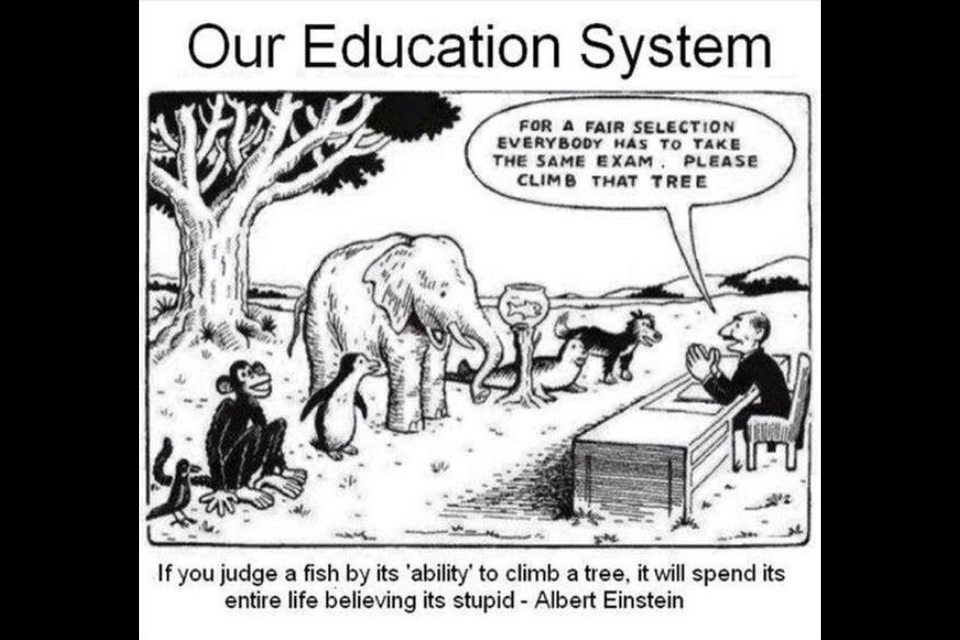


The gist of it is that some people are simply born well-equipped to succeed very easily in our educational system, and some are born doomed from the start.

I hate this comic.

I hate it because it makes it about the test … and it should always be about the students.

All children come to the educational table with strengths and weaknesses. There have been educational philosophies intended to bolster the one and ignore the other. There have been movements to teach “Executive Functioning Skills” to all, when the students that need them are going to need far more than a cookie cutter weekly lesson on notetaking to truly develop any substantive results and those that already possess strong notetaking skills still have to sit through the lessons because “reinforcement won’t hurt them”.

Students bring their life experiences--the good, the bad, and the ugly--into the classroom with them. Skin color, sexual orientation, gender identification, which end of town you hail from … those are key parts to who a student is. Ignoring that fact is a grave disservice to not just students but people in general. As an approaching-middle age white woman raised in an affluent family, how can I presume to understand what it feels like to be anything else?

And haven’t my life experiences shaped who I am and the decisions I make? Am I like any other other approaching-middle age white woman raised in an affluent family? Of course I’m not. I was seven months pregnant at my high school graduation. I drank heavily in college. I was raped by an acquaintance. I was hospitalized for a month with pancreatitis in my twenties and for a month with post-surgical complications when I was forty. I have lost a parent. I suffered horrible abuse from my abusive alcoholic/addict ex-husband. Would anybody know those things about me by looking at me? I repeat, though, haven’t they shaped who I am? Would pretending they never happened be doing me any favors?

I heard a colleague become very angry at a recent training intended to drive home the idea that it is doing kids a disservice to say, “I don’t see Bobby as a black kid. I just see Bobby as a kid” or “I don’t see my cousin as a lesbian. I just see her as a person.” “I’m colorblind!” she said over and over. With that mindset, we are taking away a huge part of the experiences people have had as a result of the hand they were dealt.Teachers cannot even begin to tap into the difference we can make to children if we refuse to see their colors, their shapes, the fact that they work a full-time job to help their mother pay rent.

I’m pretty sure this colleague is in the minority, but it is a vocal minority.

Teachers that take the time to know their students--and I believe that most of us truly do--will take into account the many and varied experiences, good as well as bad, that each child has experienced. To do otherwise is to do a disservice.

We look at where they are at when they come to us, and we do everything in our power to push them ever higher. We show them pathways, we encourage them, we are open and honest with them when we think they are making a mistake, and they will and do listen to us.

Sometimes, though, they ignore us. This is true of students from all races, creeds, sexual orientations, socioeconomic statuses, mental illness, addicts/alcoholics, and so on.

Sometimes, no matter how much we care, no matter how much we try, teachers can only do so much.

And here is the elephant in the room, the elephant that nobody wants to talk about, the elephant that frightens me terribly even as I write this. I am, after all, a public school teacher that loves her job, and I do not want to be squashed by that elephant.

I think my point can best be made with an anecdote.

My first teaching job was at a middle school in a large city. I had a minority student, “Victor”, in my Honors class. He was a strong student and an incredibly nice kid, the kind of kid that would stop and help you if you dropped a huge jar of M+Ms in a busy hallway. Victor was a straight A student across the board, and he could have pursued and excelled in any career path he wanted.

Increasingly, Victor came to school with bumps and bruises. Once, he had a tooth knocked out. Because I was young and idealistic--and most of all “colorblind”--I pulled Victor aside and asked what was going on. “Just some guys giving me grief,” he said, cheerfully enough. “It’s no big deal.” I wasn’t so sure about that, but Guidance told me that it’s a common occurrence and, if it happens off of school ground, there is nothing they can do.

I thought they meant fighting and tried to forget it.

One day, I was leaving work and Victor was sitting on the sidewalk in tears, his vandalized and unrideable bicycle next to him. I ran over to him, and he quickly stood up and wiped the tears from his face.

“I’m fine, Mrs. L,” he said.

“What can I do to help you?” I asked. “Do you want a ride? Do you want me to bring your bike to a repair shop? I’ll pay to get it fixed, Victor. This is horrible. We need to call the police.”

Victor looked stricken at that. “Please, Mrs. L, just leave me alone.”

“But … why, Victor? You are such a nice kid, such a smart kid, why would anyone do this to your bike? Why would they beat you up?”

“You really don’t know, do you?”

Almost in tears myself (please remember, I was twenty-four at the time), I shook my head.

“They used to be my friends, but now they don’t like it that I do well in school. They keep saying I decided to ‘go white’.”

“‘Go white’? I don’t understand.”

“In my neighborhood, in my family, we don’t take honors classes and get straight As and awards from principals. We stick together. We don’t try to be better than what we are.”

“But … you’re a straight A student in Honors classes. You can do anything you want, Victor.”

“I know,” he said with a sunny smile. “That’s why I don’t let this stuff bother me.”

The next day, Victor was not in school. He had been badly beaten for talking to a white teacher outside of school. He came back to school a few days later, determined as ever to break the mold. I left the district to take a job closer to home, but I remember thinking that Victor would be okay; he would be a success story.

I returned to that district at the high school level two years later, missing the size and the diversity and the unique challenges that I loved working with.

I saw Victor once, in a crowd of students in the same minority group as he. He saw me, did a double take, then looked away. Confused, I went on my way. I did ask around, though. Victor was a D/F student in low level classes. He was involved in gang activities. Rumor had it he’d been in police trouble on several occasions. He was no longer “a nice kid”.

I have no idea what happened to Victor, the story that transpired in the years I worked in a different district. I do know that he changed dramatically, that he had clearly made the decision that ‘going white’ was no longer his path.

It was not the school staff that did this to Victor, nor was it necessarily his family. Victor had, somewhere along the way, lost the strength to stand up to his peer group. He had accepted his peer-defined identity of who he should be as a minority, and that identity did not value Honors or AP classes, never mind school itself.

Nobody wants to talk about the power of peers when it comes to minority groups possessing an “Us versus Them” paradigm, but that is the very base of it. I say that from fifteen years in education.

It is the elephant that nobody wants to name because we fear being labeled racist even as we squawk about being colorblind.

I take each child that I am given the privilege to teach, and I work with them from where they are at on what they are able and willing to give and receive. I truly believe that most teachers do the same.

So why am I writing this today?

The city I live in is in upheaval over student representatives being added to an ad-hoc school board committee tasked with exploring ways to include student voice on the school board. Each high school principal was asked to choose a representative from their school. The principals, I’m sure, worked hard to ensure that these representatives were not white, Harvard-bound males. It is a diverse city, and ignoring that diversity would be wrong. Principals know their student body, and they know the student that would best represent its unique voice.

What has happened is that a group focused on community organizing, a group made up of exclusively of minority students, a group that has made derogatory and false statements about their schools, a group that has misrepresented adult leaders as students to the press, has pushed their way into the ad hoc group made up of the principal-selected representatives.

Among other things, this group has been vocal about minorities being discouraged from (or even forbidden from) taking upper level classes. They blame the schools. They blame the teachers. They blame the school board.

Victor was the most extreme case I’ve seen, but based on my experience as a teacher it is the peer groups that want to keep anyone from defecting, from ‘going white’. The opportunities are there, for minorities and for all students, if they are willing and able to work to achieve them. They are encouraged by teachers. In fact, teachers and school administration would love it if their upper level classes were a perfect balance of diversity. What a feather in the school district’s cap that would be!

But teachers and citizens that are not of this minority group do not want to say anything. They don’t want to name the elephant because “Racist” or “Sexist” or “Prejudiced” is not a label anyone wants to wear. It would be all too easy to dismiss anyone who tries to raise this issue with one of those labels without ever addressing the issue itself.

And that group? They do not want to talk about the elephant in the room either, but perhaps they should if they truly want to engage in a dialogue that leads to understanding.

Thursday, July 20, 2017

Parents vs. Schools Regarding Required Summer Reading: Both Miss the Point

My eighth grade daughter has "recommended" summer reading activities. 

She is expected to come up with three goals, write out a plan as to how she is going to accomplish them, and fill out a chart of her "summer learning activities" (this requires an "Authorized Signature", which I assume means me??, and a spot on the grid to write how it made her Grow).

There is also a suggested reading list with books selected from the Association for Library Service to Children (ALSC)’s 2017 Summer Reading List for Grades 6-8. I haven't heard of any of them, and I'm pretty sure my daughter hasn't either. None of them exactly pique my interest, and I'm a voracious reader (I should note that this particular daughter is not, although you can see from the pic below that she once enjoyed books)

Image may contain: one or more people, people sitting, child and indoor

There is also a link to a lesson plan that teachers were apparently supposed to go over with students at the end of the school year. According to my daughter, this did not happen, and the message she got from her teacher was not to waste her time because nobody cares anyway. Part of me wants to applaud her teacher for her honesty with her students regarding this.

The whole thing is asinine, in my opinion as both a parent and a certified English teacher.

And, as you can imagine, some people in my city are going wild on the issue. Largely on Facebook, of course, but this is probably where you'll get the most honest feedback.

Some samples (All SIC):
* "I don't agree with [mandatory reading over the summer] at all. Both my boys are working full time and involved with family activities. They work hard in school all year and this is the time for them to just be kids. I'm not going to spend my summer forcing my boys to read. It's time to relax and recoup. It is not a time for more school-related pressures."

* "Most kids were burned out of reading after the reading challenge in elementary school making them read makes them despise it."

* "Between football starting next week--ugh--working, visiting family, and dare I say it, just being a kid, there leaves little time to get all this done. It's too much."

* "I think summer vacation means vacation away from school. If you had a vacation off from work and they asked you to do something over that time period you'd think twice about it. J/S."

There are many, many more, but that probably makes the point. And, to be completely fair, there are lots of intelligent, invested parents rebutting these kinds of statements.

Like me, they seem to focus on the idea that kids should be reading *something* in the summer, not just a book from an arbitrary list. Like me, many are appalled that some see reading as such little value. Like me, the idea that having to find time for reading is troubling bothers them.

Children should NOT stop learning because it is summer vacation. My daughter has learned, to give a small sampling, how to put up a pool and monitor chemicals, how to cook a meal, how to hike, how to teach her little sisters to swim, how to beat Super Mario Brothers, how to zipline, how to do different types of French braids, how to survive her first sleepaway camp, how to play the ukelele, how to master gymnastics skills she's been practicing ...


She has also been reading, albeit reluctantly.

She reads a graphic novel series that her father buys one of each month for her. She's reading Thirteen Reasons Why because she was interested in the difference between the book and the Netflix series and whether the story was helpful or harmful to teens (we are both English teachers, so she's heard lots of conversation on that topic) and wanted to be educated enough to weigh in.

She is currently at sleepaway camp (I miss her so much ...), but when she gets back, we are going to require structured reading time. We are going to know what she is reading and discuss it with her. We are going to recommend books to her and read them along with her. She will not love this, of course, because she is not a natural reader, but she will go along because she understands that reading, that learning, is important.

I am not going to require her to fill out those forms but instead keep a log of what she's read and a sentence or two of reflection.

I am going to encourage her to continue swimming, hiking, hanging out with friends, playing with her little sisters, going to Canobie Lake, and whatever else allows her to be a normal thirteen-year-old in 2017.

We made a decision a few weeks ago to cut off her iPad and wireless access on her phone at 10:00 pm. She's certainly gotten more sleep, which has also made a difference.

We are also going to make an effort to go to more museums, historical sites, and that sort of thing.

That is what learning is about ... and learning should happen in the summer. Reading must happen in the summer if we want to keep our children's reading fluency and knowledge base where it needs to be.

Should the school set out a canned summer  learning recommendation list for all students without taking into account what happens at home? No. Families that value summer learning have, with all due respect, long since put things into place that are far more meaningful than what's been offered.

Families that do not value summer learning need more than a bunch of printouts (and poor printouts, at that). They need to be educated on how to turn experiences into learning, which is far more valuable than how to break down a goal into parts. They need support and explanations and suggestions for how to make learning an integral part of every day.

Am I way off base with my frustration here?  

Tuesday, May 3, 2016

Teacher Appreciation Day--Share a Story!

Today is National Teacher Appreciation Day.

As most of you know, I am a teacher (from a long family history of teachers). For the rest of this week, I am going to write posts about teachers that have impacted my life.


For today, though, I wanted to extended an invitation to you, my readers, to share stories about teachers that have made an impact on you. Those stories mean more than you will ever know to those of us that are (or have been) in the trenches).

Share stories in the comments. Share stories on Facebook. Send me an e-mail and I'll add them to this post.

Oh, and here is the official proclamation from President Obama:

Our country's story, written over more than two centuries, is one of challenges, chances, and progress. As our Nation has advanced on our journey toward ensuring rights and opportunities are extended fully and equally to all people, America's teachers -- from the front lines of our civil rights movement to the front lines of our education system -- have helped steer our country's course. They witness the incredible potential of our youth, and they know firsthand the impact of a caring leader at the front of the classroom. 
As our national narrative has progressed, we have become a more equal society, cleared paths to opportunity, and affirmed the extraordinary potential of all our people -- regardless of their race, their gender, their sexual orientation, their religion, or the zip code they were born into. But there is still work to be done. If our country's story is going to reflect the diversity we draw strength from, it needs to be written by people that represent the wide range of backgrounds and origins that comprise our national mosaic, and as the next generation rises and prepares to shape that narrative, our teachers will be with them every step of the way -- imparting critical knowledge and opening their minds to the possibilities tomorrow holds. In working to ensure all our daughters and sons have the chance to add their voice and perspective to America's story, our teachers help shape a Nation that better reflects the values we were founded upon. 
When I took office, I did so with a bold vision to foster innovation and drive change within our education system, and to expand educational opportunities and outcomes for all America's learners. Central to that goal is our work to build and strengthen the teaching profession so our teachers are enabled and equipped to inspire rising generations. I have worked hard throughout my Presidency to make sure my Administration does its part to support our educators and our education system, but the incredible progress our country has seen -- from achieving record high graduation rates to holding more students to high standards that prepare them for success in college and future careers -- is thanks to the dedicated teachers, families, and school leaders who work tirelessly on behalf of our young people. 
Just as we know a student's circumstances do not dictate his or her potential, we know that having an effective teacher is the most important in-school factor for student success. That is why my Administration has been committed to better recruiting, preparing, retraining, and rewarding America's teachers. Following the worst economic crisis our country has seen since the Great Depression, my Administration supported significant investments in education through the Recovery Act to keep more than 300,000 educators in the classroom. We have invested more than $2.7 billion through competitive grants to better recruit, train, support, and reward talented teachers and educators, and we have worked to make sure teachers have a strong voice and a seat at the table in the policymaking process. At the urging of the Department of Education, all fifty States are advancing teacher equity plans to ensure that districts can support and retain educators in schools that need them most. In my State of the Union address in 2011, I announced a national goal to prepare 100,000 public school STEM teachers by 2021 to help ensure more of our young innovators can seize the opportunities of tomorrow -- and I am proud that we are on track to meet that goal. 
I recently signed the bipartisan Every Student Succeeds Act (ESSA), which ensures students are held to high standards that will better prepare them for college and careers. And because cookie-cutter solutions are not always effective considering the diversity of our communities and of the students in our classrooms, ESSA reflects my Administration's approach to education reform by empowering States and local decision makers, who know what their students need best, to shape their own progress with accountability. ESSA also aligns with the Testing Action Plan I announced last fall to help reduce the burden of standardized testing so educators can spend less time testing and more time teaching. This law will also allow more States and districts to support teachers and expand access to computer science, a critical skill our students need in the innovation economy. 
Our future is written in schools across our country. It is likely that the first person who will go to Mars is in a classroom today. Our students are our future teachers, scientists, politicians, public servants, and parents -- a generation that will steer the course we will take as a people and make possible things we have not even imagined yet. We look to the women and men standing in front of classrooms in all corners of our country -- from cities to reservations to rural towns -- to vest America's daughters and sons with the hard skills they will need to put their dreams within reach and to inspire them to dream even bigger. On National Teacher Appreciation Day and during National Teacher Appreciation Week, let us ensure our educators know how much we value their service in the classroom, how much we appreciate all they do for our students and families, and how thankful we are for their contributions to our national progress. 
NOW, THEREFORE, I, BARACK OBAMA, President of the United States of America, by virtue of the authority vested in me by the Constitution and the laws of the United States, do hereby proclaim May 3, 2016, as National Teacher Appreciation Day and May 1 through May 7, 2016, as National Teacher Appreciation Week. I call upon students, parents, and all Americans to recognize the hard work and dedication of our Nation's teachers and to observe this day and this week by supporting teachers through appropriate activities, events, and programs. 
IN WITNESS WHEREOF, I have hereunto set my hand this twenty-ninth day of April, in the year of our Lord two thousand sixteen, and of the Independence of the United States of America the two hundred and fortieth. 

Saturday, January 2, 2016

Exploring the Concept of "Smart" in 2016

Just to get this out there, I come from an educated family.

The question was never, "Are you going to college?" but "Where are you going to college?"  My sister has a PhD in Microbiology. My mother is a nurse practitioner. My father is a lawyer. As merely a teacher, I'm in fact under-educated for my family.

I'm sure you've all heard of "book smart" versus "street smart" ... virtually everyone in my family falls in the "book smart" category, high on analyzing Shakespeare but low on common sense.

I used to buy into that line, that you were either smart at learning or smart at learning how to do stuff. Instead, I've come to believe, both as a teacher and as a person, that we all have a combination of these basic intelligence slants, some higher than others but some combination thereof.

Much of my changed thinking on the nature of intelligence is based on someone near and dear to my heart, a friendship that goes back to high school.

Let me introduce you to "Will" (obviously not his real name), an ironworker and a musician. Will graduated from high school in 1995 and has had almost exclusively labor-intensive jobs since then. (He took one college course along the way and, of course, earned an A.)


Will is gifted at working with machines and metals, often coming up with innovative solutions to problems that seem insurmountable. He does this at work all the time, and he does it in other facets of his life as well. He has done lots of work on various cars I own over the years, sometimes a simple brake job, sometimes greater challenges (one of my headlights did not work on low beam; it was not the bulb, and the mechanic couldn't figure out the problem. I kept getting pulled over for having a headlight out, but I'd take it to the mechanic and it would suddenly be working. In desperation, I called Will; he simply cross-wired the low beams and the high beams, and everything worked just fine).


I said to him just yesterday, "One of these days, something is going to come up that you will not be able to fix."

He shrugged (he's kind of cocky about his skills) and mentioned a couple of failures he's had.

Will is often on fire (literally) at his job, so he is usually dressed in dirty jeans with burns in them and t-shirts stained with steel dust. His hands are permanently discolored despite the fact that he washes them regularly. He is tall and big, wears glasses, and the overall effect upon first glance is, "Laborer. Good at his job. Not smart enough for anything more, but he looks like he works hard."


But I have known this man since we were fourteen-year-old kids. I know that he took college-prep classes and got As and Bs with pretty much no effort, that he is a bookworm that can understand and discuss literature that I studied in college (I was an English major, too), that he reads informational magazines, that he watches the History Channel, Discovery, Nat Geo, and so on obsessively.

While Will never went to college (for financial reasons, not because he didn't get a much higher SAT score the one time he took it than I did in my five attempts), I would argue that he is educated because he takes the time to educate himself--through books, through documentaries, through conversations with experts.

And then, of course, there's Will's other passion--music. He has been playing with live bands, guitar and bass guitar, since we were in high school. Music is an art, but it is one that requires strict discipline and regular daily practice. He is a gifted musician, can tune a guitar in minutes (and tell if it's out of tune in a nanosecond or two), and is able to think on his feet quickly enough to stay in synch with other band members.

When ice fishing or boating or hiking or fixing cars or replacing drywall or rebuilding a garage, Will keeps us a running commentary on what is happening or why. He's taught me, among other things, that you can see where stripers are running by watching the seabirds flocking; that setting up a tent requires a lot of concentration (but not a manual); that you need to hold a nail gun flat and squeeze the trigger quickly; that you should be absolutely sure that you got the right oil filter before asking someone to change the oil on your car; that you should take the cover off the brake fluid reservoir when doing brakes; that getting your mom's Jeep stuck in a mudhole isn't totally insurmountable (but it will not be clean); that there is one person in the world that I have never beaten at chess (Will, of course); that meals should always begin with onions, mushrooms, and garlic and almost always include beer; that Lord of the Flies was a depressing book because the boat that came and stopped the massacre of Ralph just in time was itself on its way to massacre human beings; and about a million other things over the years.


Both in terms of learning (book smart) and in terms of learning by doing things (street smart), Will is the smartest person I know.

If you met Will, though, I doubt that you'd share my opinion on that. He often looks like a big dumb dirty ironworker (and will, in fact, often say, "What do I know? I'm just a stupid ironworker". The idea that he could be not just street-smart but book-smart might appear ludicrous. I stand by what I said, though.


Will might be the only person I know that is incredibly "smart" both innately and by education, but I have recently started to notice the different combinations that make up people I know.

My father, a lawyer, has always enjoyed building stuff. He used to be terrible at it, but he has improved greatly over the years. Carpentry is a learned skill for my father, not an innate one, but he is good at it.

A family member was recently hanging a TV and needed some help. I am married to a highly educated man with some innate intelligence, and he went and mounted the TV for my family member. I could not have done that as I have no knowledge whatsoever of wall studs and such, yet I have a beautiful college transcript (both undergrad and graduate) that contains more As than other letters.

In 2016, "smart" means something different different than it has traditionally. I am convinced that we have to focus not on book smart vs. street smart but on knowing and understanding the checks and balances necessary to maximize our own innate potential with education.

What are your thoughts?

Tuesday, September 15, 2015

Today's Lesson Flopped ...

It's easy to understand why teachers get jaded, especially after a day like today!

After eleven years as a classroom English teacher at the secondary level, I made the change to a Literacy Interventionist (basically a Reading Specialist). I get to work with kids of all ages, and I get to run diagnostics to figure out their strengths and challenge areas and then design individual programs to address those specific needs (and bolster specific strengths). 


I love my job, but at times it is very frustrating. I have one class that has me digging into the very dregs of my bag of tricks, and I'm coming up empty.

If you imagine struggling readers at the middle school level, you can probably imagine that sitting in a desk doing seatwork is not going to fly for these kiddos.

With this particular crew, I'm working with their core academic teachers to provide support through pre-teaching vocabulary, exploring articles in advance, and allowing class time to work on writing assignments. 

Teaching content vocabulary has been a flat-out nightmare ... 

"Why do we have to do this?" "Can I go to the bathroom?" "I don't want to do worksheets!" "I can't sit still after lunch." "I have to go to the bathroom!" "You're not our science teacher!" "I really have to pee!" "Why are we doing science in here?" "If you don't let me go to the bathroom, I'll pee in front of the door."  

It's seriously like something out of a bad movie.

I've tried given students lists of words to define. They hated it. Refused to do it.

Gave them a list of words defined and asked them to use it correctly in a sentence to show that they understood meaning. Hated it. Refused to do it.

Make a visualization sketch of a word when given a definition AND sample sentence? Hated. Refused.

So me being me, I asked them for suggestions after their cries of, "This is boring!" bore completely through my eardrums. It is, I explained, my job to improve their reading skills, and working with content words for an upcoming science article will make them better prepared to read the article. 

"We're not going to read the article anyway, you know," one of them pointed out.

I shrugged. "Hope springs eternal."

Then I asked them more directly, what can I do to improve your experience? 

One of them mumbled something about wanting to do work that was a bit more hands on.

Okay! Hands on! A direction ...

And so I scoured this article for potential vocabulary words. I pulled them from the text and wrote them down onto two sets of note cards (actually, they were printed on colored paper cut like note cards by my amazing paraprofessional), one green and one yellow.

I was so pumped that I almost asked my supervisor to come observe the activity. Haha, good call on not sending that particular e-mail ...


I had them do a quickwrite about what they think would be the greatest challenges faced by miners at work (the nominal topic of the article), then I divided them into groups, gave them a stack of words, and instructed them to work together to tape each word on the correct definition written on the board.


Objectives were essentially:
* Students will be able to read grade level vocabulary
* Students will be able to use process of elimination to identify definitions for a set of word
* Students will be able to work collaboratively 

Yeah, after about twelve seconds, they started whining that they wanted to sit down because they were tired. Then they said it was too hard and they refused to do it.

I showed them strategies--read through the words and make a pile of words you know, read through the definitions and see if any words jump out at you, try to narrow down options using the definitions, et cetera. They didn't care.

I told them the winning team would get a prize tomorrow. They cared enough to try for another seven minutes before flat out giving up.


I'm only a little daunted. Thirteen years of teaching, after all, and there's more than one way to skin a cat ... or teach vocabulary, as the case may be. I'll get back on the horse tomorrow and try to come up with some other creative way to reach these reluctant readers.

Today, though, I'm wallowing in the experience of my lesson flopping.

Monday, September 14, 2015

Equalizing Education? Not with This Obstacle ...

While the United States provides public education to its population, the quality of such is all over the map. It's simply unavoidable.

There are many and varied reasons for this, of course.

School districts that pay their teachers and administrators well are likely to retain a strong, talented staff of educators. The converse, of course, is also true.

Larger schools have a larger pool to pull from in terms of athletic teams, extracurriculars, and students to fill in Advanced Placement classes.

Smaller schools often provide a family feel, where students and staff know each other well and would go to the mat for each other. 

Inner city schools are frequently rich in culture and diversity.

Consolidated country schools offer original electives such as cow care and snowmobile mechanics.

Whether we are using "Common Core", sold as the great educational equalizer intended to level the playing field, or not, there is no question that schools are vastly different. I live in New Hampshire, and my children have gone to three different school districts. Extremely different.

Are all New England Schools alike? Of course not. The South? Runs the gamut, I'm sure. California? The so-called Bible Belt? Alaska or Hawaii? 

It's hard enough to compare schools in one state or one region, but let's be real; no two schools are alike. I've been an educator long enough to know that each and every school has both significant strengths and weaknesses.

There is--I'm just going to say this--no way to uniformly educate the children of America. Geography, finances, quality of teaching staff, and so on ... it's just not possible to enforce uniformity.

And that's okay ... because the biggest obstacle facing American children in 2015 is none of those things.

Nope, my theory is that the detriment to American schoolchildren is their families.

Wait, their families? Not the Common Core? Not teachers on strike? Not shoddy materials? Not shabby facilities?

That's right. Their families.   

I learned early on that, when I asked my eldest daughter, Emily, how school was, the inevitable answer was, "Fine." It took me a few years, but I eventually learned to ask direct questions. What was on the history quiz? Are you enjoying Of Mice and Men? What music are you playing in band? It was harder for her to give monosyllabic responses to that.

And then Ari came along, and she couldn't talk about school enough. Well, let me rephrase that ... Ari couldn't talk enough about the social aspects of school. The kid should have written an elementary school gossip magazine. However, I'd learned from her stoic sister that specific questions led to discussion, so I ended up hearing all about her classes as well.

Yup, it was pulling teeth to get any sort of curriculum conversations going with either of them, excellent students both ... and I'm a teacher.

I wonder sometimes how many parents want desperately to talk about school with their kids, to analyze Steinbeck and conjugate Latin verbs and weigh the pros and cons of the Vietnam conflict. I suspect the number is large, even for those that never have said conversations. Children can be tough nuts to crack, and if school is their private world they might well want to keep Mom and Dad out of it.

I persist, though, and I think a lot of parents do as well. I have a fairly good idea of what's going on with each of them, even though Emily is in college now (hating her astronomy class, disappointed in her language acquisition course, and learning lots in history of the English language) and Ari is a middle schooler (exponents in math, warning sign identification in science, the story behind their first name in Language Arts).

It would be really easy for me to say, "I'm an involved parent. I talk to my kids about school, even digging for details. I check their homework. They ask me for help when needed. I am so involved it's not even funny." 

Except that's not precisely true.

Personally, I hate big crowds of people I mostly don't know. Going to open houses and festivals and concerts and such bring on anxiety attacks. I know Ari would like it if I volunteered at her school (if I had the free time) or took her to middle school football games or encouraged her to have friends over. Sometimes I can even handle this, but much of the time, I can't. 

Also, I could stalk the online grade program and/or e-mail her teachers all the time, but I don't want to be a pain.

Overall, though, parental involvement should not be a concern for me, right?

Wrong again.

Parental involvement is a problem for everybody!

The biggest problem shared with me by both Emily and Ari is one and the same: the other kids act like monsters and keep the teacher from being as effective as he or she would otherwise be.

You might say, the teacher should send the kid to the office. The teacher should call home. The kid should be punished. This shouldn't be allowed.

Sadly, these kids have missed out on a lot of learning when they languished in the office. Phone calls home run from, "Well, he says you have it in for him!" or "Everyone else was throwing spitballs, too" to, "That's a school problem. I have a hard enough time dealing with him at home." 

Because those parents enable, make excuses for, or give up on their children, my children miss out. 

Is that fair to my children? No ... but yes. You see, my children have had to learn to extend their education on their own. Instead of being one of those obnoxious and overbearing parents that call teachers the second week of school and say, "My child is bored", I strive to teach my kids to read more, to list questions about topics in history class that we can discuss as a family later, to write in a journal. My children are bright and successful, but I would never extol them as special snowflakes.


Parental involvement is a multi-faceted thing. It's not just talking to kids about school. It's not just having sports dates and days off written on the calendar. It's not just going on teacher websites. It's not going to school events, whether you want to or not.

It's all of those things, and it's more.

As a parent, I raise my children fully aware that their teachers are playing a role in their upbringing as well. As a teacher, I buy everything from lunch to deodorant to tampons to notebooks to sneakers for my students. I teach them English, but I also teach them manners and respect.

But it's an uphill battle.

Until parents are unified in their view of what education means for American children in 2015, the problem will exist. In fact, it will get worse. Parents work long hours. They are too tired to attend school events. They might not have transportation, and it's increasingly common for parents uncomfortable with speaking English to avoid going into schools out of fear and discomfort. Kids are seduced by drugs and gangs and horribly short skirts from American Eagle. 

The only way for education to be equalized is for parents to become fully invested in their children's schooling. Only then can we all work together to provide a high quality, equal education to every student. 

Friday, February 17, 2012

The Education Conundrum--How to Teach Every Kid?

Yes, I'm still out of work ... one more day, according to my recheck yesterday with my primary care doctor.  I'm resting on the couch with my computer (I seem to be okay until I get up and start moving around, so I guess this counts as resting, which is the big word in my recovery ... I mentioned that I'm a failure at resting, right?).

Anyway, I got talking to some friends in the education world (many of my friends are teachers, which I suppose is only natural), and we got talking a lot about the education conundrum--namely, how to teach every student (I will not insult anyone's intelligence or fan flames of government distrust by using the words "no child left behind").

Schools are in different places.  VASTLY different places.  I have to say that, if nothing else, I was pleased to learn how truly cutting edge my school is in a lot of ways.

Anyway, I view education through three lenses--as a former student myself, as a parent, and as a teacher.

My hope with this post is to generate conversation.  Nothing would make me happier than for the comments to fill up, for people to share their thoughts and experiences, and for all of us to do a little thinking, a little learning, a little growing.

And, okay, I want to write a professional article on the state of education today for a national ed journal (I actually have a Master's Degree in education along with a B.A. in English ... I just play dumb sometimes ;-)).

Just to get a little bit of jargon out of the way, I want to give you two words which have significantly impacted my own philosophy of education: Personalized Instruction.

Basically, this is the notion that every effort should be made to make learning accessible to all students.  Obviously, writing a separate curriculum for every single student is patently impossible, but allowing students some voice and choice, trying to make learning interesting and relevant to all students, considering that there are many different ways to demonstrate knowledge ... yeah, it's hard to explain (and also VERY hard to do), but hopefully that makes some sense.

KLO AS A STUDENT
I learned how to read when I was a toddler.  While it sounds impressive, it was actually a huge detriment to the basic foundations of my education.

Why?  Because, while I learned early on how to delve into literature, to lose myself into the magic of a story, I never learned how to read strategically.  If I had no interest in reading something, I wouldn't.  If I was assigned a chapter in a science textbook or a history article or something, I simply couldn't force myself to do it.  I had no skills for how to read something that was difficult for me, and I never learned how to do that until I was a teacher myself.

Between the precocious reading and strong skills in writing I demonstrated at a very early age, I managed to write my way into correct answers for most of my school years.

And math?  Yeah, let's not even go there.  To this day, I cannot add two digit numbers in my head, never mind multiply, divide, or subtract.  I was too busy reading--and reading what I wanted to read, at that.

Because of the way tracking was done at my school, however, I could not take Honors English and Pre-Algebra.  I had to make a choice, and so I ended up in Algebra I with no preparation at all.  Math, which had always been hard for me, became a nightmare--I walked into Algebra I thinking that "X" meant multiply, and it only got worse.

I carried the "laziness" burden around with me for most of my school career.  When I was a high school junior, I finally convinced my mother that I really was trying, and I got evaluated, tested, and diagnosed with two learning disabilities, one in auditory processing ("in one ear and out the other" was the story of my life) and one in spatial awareness (explains why math is such a struggle).

I also learned, as an adult, that I have ADHD, which retrospectively explains why I long struggled with focusing, with completing tasks, with making good choices, and with basically sitting down and shutting up when told.

If my teachers had been trained in personalized instruction, in student-centered learning, school would almost certainly have been a more positive experience for me.    

KLO AS A PARENT
Like all parents, I want my kids to get a good education, to learn lots, and to be successful in school (as measured by things other than report cards and test scores).

Addie is a senior now, and she has always been tracked into high classes.  She's in her second A.P. English class this year, and she just started French V.  .

Addie is extremely bright, but she's also a very lazy student.  She knows how to get by; she learned early and well how to play the game, how to jump through the right hoops.  She's always gotten good grades, but I wonder sometimes how much she's really learned.

The SAT experience was a perfect example of this.  She took the SATs, did slightly above average but not good enough for the schools to which she's applying, so she did a bunch of prep-work, figured out how to raise her scores, and received exceptional numbers when she retook it.

She is also--and I know she'll read this and probably freak out, but it's God's honest truth--an academic snob.  When she is taken out of her Advanced Placement ivory tower, she gets very frustrated with her less book-smart classmates.  The superiority complex she's developed as being one of the "smart kids" has not prepared her for the real world, nor has it given her the skills to teach herself when the going gets tough (as it inevitably will when she starts college).      

Addie's education has been largely what I refer to as "old school"--ability grouping, lots of paper and pencil tests, little opportunity for collaboration with peers, and so on.  I'm pleased with the education she's received (and I'll be proud as heck at graduation that she's going to be among the "chosen ones" wearing the National Honor Society cord), but I'm also aware of its limitations.

Belle's school approaches education very differently.  It's all collaboration, groupwork, projects that might or might not be reflective of a child's efforts (you can read my rant on a recent situation here, if you so desire), and so on.

Belle, who is also a very bright kid, takes great pride in helping out classmates that struggle.  I'm pretty sure she's more computer-literate than I am.  She loves conferencing with her teacher about everything from her writing to the books she's reading.

At Belle's parent/teacher conference a couple of months ago, I got the unmistakable impression that her teacher knows Belle as a learner, is well aware of her strengths and challenge areas.  I have no doubt whatsoever that her teacher (who is absolutely outstanding, by the way) personalizes instruction for Belle and her classmates.  

That being said, I worry that Belle is, at some point, going to hit a wall as well.  As the gaps between "the smart kids" and those that struggle widens, the personalization piece becomes increasingly challenging.

Is it fair to expect Belle to "self-teach" while the teacher focuses on skills she's mastered with the rest of the class? Should Belle have to do the lion's share of the work in group projects?  Is there going to come a point in time when she, like Addie, realizes that it's all about jumping through the right hoops at the right time?

Unlike Addie, Belle is a child absolutely driven by intellectual curiosity, so I'm hoping that she'll manage to avoid those pitfalls.

KLO AS A TEACHER
Personalized instruction has become extremely important to me as a teacher.  Like, it's the driving force of my personal philosophy of pedagogy these days.

I know my students.  I know them very well, their strengths and their challenge areas.  I know the specific ways to motivate each kid (sometimes it's positive reinforcement, sometimes it's the iron fist, sometimes it's calling home, sometimes it's bribery with doughnuts, and so on).  I know what each student is capable of, and I know how to help them set realistic goals for improving their reading and writing skills.

I know which kids freeze up during paper and pencil tests, and I know enough to go over failed assessments orally with them so they can demonstrate that they do in fact know the material being assessed.  I know that, if a student is missing an assignment, I can get him or her to make it up pretty quickly by staying after school with me or eating lunch in my classroom.  I know that, even though my students make fun of me for being lame when I make a big deal over them understanding complex literature, it invokes a sense of pride in them.

It's actually not as impressive as it sounds; I work in an extremely small school, and we are fortunate enough to have very wise district-level administration that arranges for consultants to be brought in to train teachers based on specific need (kind of like personalizing instruction for teachers ... genius, really).  The district admin is also quite gifted in grantwriting, which makes a lot of things possible that wouldn't be otherwise.

The friend that was most frustrated during our recent conversation works in a huge school.  HUGE.  He was distraught because a high percentage of his kids failed the first quiz on a play they are reading aloud as a class.  Each student had a study guide, encouragement to take notes during class discussions, and plenty of opportunity to ask for clarification knowing that an assessment was forthcoming.

"I don't know what else I can do!" he lamented. (there might have been a F-bomb or two thrown in there as well ...)

I probably didn't help much.

I suggested the idea of differentiated assessment (in other words, giving kids a choice of how they want to be assessed on the material).

It's actually not as loosy-goosy as it sounds; if your performance assessments are rigorous, which they should always be, and they are measuring the same thing as a traditional quiz, does it really matter how the students demonstrate the knowledge?

My friend was assessing whether students could identify the characters and major plot points from the first section of a work of literature.  The assessment was matching, fill-in-the-blank, and multiple choice for quotation identification.  While students are given the option to re-take the quiz if they fail, their potential grade caps out at a 70 for a restest.

The reason for this, as texted to me by my friend this morning?
The cap is a result of A.P. parents bitching to the school board about how unfair it is to their kids that someone with "more time" can get the same [grade] as their child, who "did it on time".
As the parent of an A.P. student, I find this appalling.  If I want Addie to be challenged--and I do--then it would be my (and, presumably, her teacher's) expectation that she be held to a different (and definitely higher) standard than a kid that can't read.  That seems like a no-brainer to me.  

According to my friend, every student (not just in his particular section of the class but those taught by other teachers as well ... huge school, remember?) is supposed to do the same assessment for an agreed-upon work of literature.  The same paper and pencil, boring as heck assessment.
The attitude is that standardized tests aren't done that way, so we're not helping them if we don't give uniform assessments.  "Students need to learn to take ALL forms of assessment" is the attitude of the consultant who makes policy.
I gave a recent assignment to my students where they had to write a letter to Romeo or Juliet from the point of view of another character.  The rubric was very specific and, in my opinion, very rigorous.  They had to identify and describe at least three plot points from Act I, they  had to demonstrate their knowledge of a character by taking on his or her persona, and they had to make a judgment as the character on their impressions of Romeo and Juliet's first meeting.

I could have given them a multiple choice test.  I could have said, "Write a summary of Act I".  It accomplished the same objective, after all; I mean, I could tell by the letters if my kiddos understood the play so far.

You know what?  They had a freaking ball writing those letters.  A large number of kids challenged themselves (with absolutely no prompting from me, I might add) by attempting to write their letters in Shakespearean language.  One of them, writing as Mercutio, talked about being very busy with his "interest in Indian opiates" after referencing Mercutio's vision of Queen Mab.

Kids who would have flat out refused to write a standard summary, who would have randomly picked letters on a multiple choice quiz, became engaged in this assignment beyond my wildest dreams.

Now, please don't get the impression that I think I'm the world's greatest teacher.  I'm definitely not.  I have lessons flop all the time, although since I've received training in inquiry-based learning, in increasing student engagement, in allowing students a degree of choice in what they are doing, in looking at bottom line objectives tied to curriculum standards instead of hoping that they'll circle the right multiple choice letter, it happens a lot less often.

So why is the idea of at least exploring this sort of student-centered instruction and assessment so abhorrent to some schools?  According to my friend, it comes down to three letters--SAT.  I'm guessing "NECAP" is in there as well (that's the state standardized test that decides whether or not a school is "failing").
The major problem in this district is that the entire system is built on the idea that every kid should be on a path to college.  Therefore, every kid must be able to do well on the SAT, and therefore they must be able to do that sort of test.
I think it's an even deeper problem than that, though.  I'm totally convinced that half the reason students flub the SAT is that they have never been engaged in school, they have experienced little to no success in school, and so they walk in expecting to bomb the SAT ... and we all know how powerful self-fulfilling prophesies are.

Will a student suddenly do a 180 because he or she experiences success by summarizing the first part of a work of literature in an unorthodox way and subsequently blow the SAT out of the water?  No.  Of course not.

But if students can experience success at school, if they--dare I say it--actually push themselves to go above and beyond merely identifying plot points on a multiple choice test because the assignment is *gasp* kind of fun, I don't see how that can be seen  as anything but positive!

And there is no doubt that, in this day of standardized testing as the be all/end all, we have a responsibility to teach students how to take a test.  It only stands to reason, though, that the likelihood of those "test-taking lessons" going over well increases exponentially when you're dealing with students with some degree of school buy-in.

And that's not going to happen if all they have to look forward to are circling letters (and, just in case anyone's wondering, "B" has been proven to be the most common multiple choice answer ... when in doubt, go with "B").

Please share your thoughts on this very serious crisis in America ... I like to think, learn, and grow as much as anyone :-)

Monday, February 6, 2012

Teachers and Relativity ... and Masochism

I figured out today that my standard "workweek" is somewhere near 80 hours.  Yes, I'm serious.  (I'm also something of a masochist when it comes to work, so to be fair you should probably figure that in)

This is why I'm wondering why teachers, who work incredibly hard and are entrusted, via in loco parentis, with the safety and, yeah, upraising of a veritable battalion of students, always seem to be on the political defecation list.

I don't want to hear, "You have every summer off."  No, I don't ... I'm working a second job (usually summer school ... this year, it might be flipping burgers) for the full month and parts of two others that I'm not teaching.

I don't want to hear the downright scary stuff coming down on teachers from the New Hampshire legislature ... walk in my shoes for a day.  In fact, never mind MY shoes ... my shoes are pretty comfortable as I am very fortunate in many, MANY aspects of my job (such as the fact that I have the most amazing students).  Put on the wingtips or sensible pumps of some of my colleagues ...

Sorry about the incoherent rant ... I've had Ambien and it's clearly showing, but this one's been coming for awhile.  I'll write a more ... well, coherent post about it soon.

Until then ... thank a teacher.  Seriously.  It totally means the world!

Wednesday, August 24, 2011

A Communist Plot? Crazy How Thought-Provoking Jokes Can Be ...

This has been the summer of educational conferences, which of course I knew when signing on the proverbial dotted line ... and I can honestly say that I will be a better teacher next year because of all the professional development work I've done this summer.

A lot of times, particularly in my early years of teaching, I found professional development stuff to be pretty much a good opportunity to zone out, to count dots on ceiling tiles, to plan units and lessons completely unrelated to the topic at hand, and so on.

But the absolute highlight of my summer professional development work happened this week when I ended up partnered with my colleague and friend Bob, who is kind of like my big brother at work.

I wore a red and white striped shirt to a schoolwide assembly last year, and he had the whole school calling me Waldo.  I scratch my nose with my middle finger when he walks into a room.  He's a trip.

I also taught his daughter 9th Grade English and am on a committee with his wife, so I do know a more serious side of Bob, but that was not what was memorable this week.

So we're told by the training facilitator to choose a controversial subject that we can argue one side of and then get together with a partner.

Yeah, I ended up with Bob.

Anyway, the directions were for one person to present their case while their partner listened and, after a set amount of time, the listener had to ask "probing, open-ended questions" that did not give away his or her personal feelings or opinions on the subject.

I talked about a New Hampshire Senate Bill currently under discussion which would expand the use of excessive force.  I'd just read an article about it, and I found myself really interested.  Surprisingly, Bob asked some good questions and made me think quickly on my feet (he later told me he agreed with me that, particularly when you consider the chaos that the word "bullying" has led to in schools, this is a can of worms it would be best to avoid), and that was good.

And then it was Bob's turn.

He argued that line dancing should be outlawed in America because it is a communist plot intended to take over the world.

Yeah, it took me a few minutes to stop laughing, but when I really listened to what he was saying, it was amazing how well he could fit it into the paradigm of communism.  I can't remember his exact arguments because I was trying really hard not to roll around on the floor in helpless guffaws, but it was priceless.

And that is what I love about the possibilities of contemplation coming up in so many different places.

Clearly, Bob was joking, and when he stated his position with a completely straight face, I was laughing so hard I was crying.

However, the scary thing was that he was able to make a very valid, logical, well-thought out argument in support of his (albeit absurd) thesis.

So while it made for a good laugh, it reminded me that you can learn a lot from the absurd, the ridiculous, and, perhaps most importantly, people you disagree with.

It's all about the thinking.  It always is :-)

Thursday, August 11, 2011

Do Social Networking Sites Have a Place in Education?

During the past three days, I've been away at an education conference.  As usual, it was equal parts invaluable and exhausting (our school team met way into the wee hours each night after a full day of workshops).

The gist, in case you're interested, is the significance of inquiry-based instruction (letting students guide the direction of their education through individual choice), authentic assessments (providing students with real-life chances to show their work, such as writing a complaint letter to an actual company instead of just having them write a generic letter to go into a classroom portfolio), and personalizing learning.

Yeah, really thought-provoking stuff.

One of the neatest parts, however, was that each school brought students with them to take part in the conference, and the kids went to workshops of their own as well as lending their voices to the conversation as a whole.

The final day began with a presentation of some technology-based work students had done in a workshop, and it brought up a topic of debate that I found utterly fascinating.

In 2011, most teenagers live a great deal of their lives online through social networking sites, Facebook in particular.  How amazing would it be for educators to tap into the potential offered there, to engage students in the technological language which is really their native tongue?

I'm a pretty technologically-savvy teacher, and the idea of Tweeting assignments en masse or offering discussions through Facebook is incredibly exciting.

But it's a double-edged sword, so to speak.  As one of the students attending the conference noted with regard to the issue, "With great power comes great responsibility."

And that can be scary.

Most school districts have policies in place that prohibit teachers from interacting with their students online.

Obviously, I understand the reasoning behind this.

At least once a month, I have to say to students, "Please stop talking about that [insert party, couple, thong you're wearing, pornography you bought, et cetera here]."  There are a lot of things that I, as a teacher, just don't want to know.

With Facebook, there would be no getting around it, and there are a lot of times that you have a responsibility to report things.  It would open a downright gargantuan can of worms.

I have a Facebook, but it is pretty well blocked.  The reason for that is that I'm human, and I've been known to put up posts such as "Oh captain, my captain" or "The doctor is in" when I'm out drinking with friends (speaking of double-edged swords, how about smartphones, which make it so easy to access Facebook when maybe you shouldn't be) that I would never want my students to see. There are also private pictures (such as this "phallic art" that my friend Andy and I once did with drink garnishes ... um, yeah, you really had to be there).


A possible solution, for me at least, is that I could potentially create a Facebook account as KLo, the teacher, not KLo the person.  I would, of course, keep it squeaky clean and completely focused on high school English curriculum.  I could even, I suppose, make a Facebook group intended solely for English class.

The remaining problem, however, is twofold.

1.  If I had access to my students' Facebooks and they posted something that should be reported, I'd have an obligation to do that if I was aware of it ... and the ACLU might well have a field day.

2.  I'm not a creeper and wouldn't go looking at my students' pictures and such, but there are unquestionably teachers that would.  There are predators all over the place, and the field of education is not immune from them.  Schools are, to a great degree, controlled environments where having inappropriate relationships take a large measure of skill and evil intent.  With Facebook, there would be no safety net for students (or for teachers, either, considering that accusations could be made in either direction).

Yeah, like that kid said, "With great power comes great responsibility."

There are sites out there for educators that simulate Facebook (Ning comes to mind), but as that same wise student pointed out, why would a kid bother to go on yet another site when he or she is already on Facebook?

It's a conundrum, all right, and not one with an easy answer.

It's a moot point for me personally since I wouldn't be morally comfortable exploring the far reaches of cyberspace with my students even in my school didn't have explicit policies on the subject.

It's a conversation that is going to have to happen sooner or later, though ...

The students were collectively convincing on that subject.

Monday, August 1, 2011

Anyone Want to Be a Guest Blogger? Read for Details ...

I've noticed a lot of "guest blogging" going on lately, and I figured I'd try out the idea.

Somehow, my blog has accumulated over 200 followers (thank you all so much <3), which is pretty exciting.  What I was thinking would be even more exciting is for an occasional guest post, which will allow me to participate in discussions that don't originate with me.

I started this blog to share my thoughts on the world and on the philosophy that exists in everyday life.  It's become more (my aspiring writing career, motherhood and other details of my personal life, and the field of education are all directions I hadn't planned on going in but somehow have), but that's still my underlying goal.

If you'd like to write a guest post on a topic that generates thought and discussion, please let me know.  I'm not picky about specifics beyond getting people to think and talk about the different directions capable of moving by the human brain.

Send me an e-mail with "Guest Blogger" in the subject line or leave a comment here with questions or queries (heh heh ;-)), and let's get this thing cracking.

I look forward to hearing from you ... and to moving this blog forward in new and interesting directions.

<3 KL

Saturday, July 16, 2011

Living With Learning Disabilities as an Adult

There is a basic assumption that I am intelligent because
a) I'm a teacher
b) I have an advanced graduate degree
c) I'm a writer (not prolific, true, but one of these days ...)

This is kind of a difficult topic for me to get into because it crosses into the personal more than I'm necessarily comfortable with, but I strongly believe that this is a topic that is under-addressed in society.

I found out when I was a junior in high school, after eleven years of public education, having my IQ tested numerous times (it's in the "superior" range, but I miss out on "genius" by a few points ;-)), and being dismissed as lazy and academically apathetic by virtually all of my teachers, that I have two specific learning disabilities. Several years later, ADHD was added to the mix.

I never had an IEP (special education plan) because my mother did not want me to be enabled. Her philosophy was that life was not going to make accommodations to my disabilities, so I might as well get used to it. Furthermore, I was pretty much about to graduate high school by the time anything would have been in place, so what was the point?

My disabilities were identified through an assessment done at Children's Hospital in Boston, and I cannot say enough good things about that experience. The staff there gave me specific ways that I could take control of both my education and my life (such as recording teacher lectures with a tape recorder, taking tests in silent locations, and so on), and I was a straight-A student my senior year of high school (good thing, too, considering the spotty transcript that preceded that year).

What I had that many students with disabilities don't is an exceptional strength that offset the weaknesses to a degree that I could function to some degree. In my case, of course, it was in the area of reading and, even more so, writing.

I could write an essay about something that I had no idea about, and my teachers would read them aloud as gold standards. I always felt a little guilty about this, but it was how things rolled.

I also have a quasi-photographic visual memory, which has probably been an even greater boon. If I see something, I will remember it with almost total recall, which is kind of a cool skill, I suppose. I am the master of the game Memory ;)

As an educator, I know that there is a label for students like I was--"twice exceptional", which basically means that I had both disabilities and areas of incredible strength.

But my intent with this post isn't to talk about my educational experiences, which would be, I suppose, kind of an interesting post in its own right and might happen one of these days.

No, it's to contemplate how my abilities, much as I know and understand them, have impacted me as an adult. This is an important discussion, I think, because schools today are actually really quick to identify students as disabled, to mass produce IEPs and 504 plans that provide what amounts to "blanket coverage" to ensure a degree of success in school but does not necessarily prepare a disabled child for real life.

I can't speak to a lot of disabilities, but I can bring up the three areas that I have personal experience with.

#1: Auditory Processing

There is absolutely nothing wrong with my hearing, per se, but I miss a lot of what I "hear" because there is a crossed wire (or something) in my brain that doesn't allow me to process what I hear.

This is one of the reasons that I avoid the telephone. It's not that I don't want to talk to people, but if there is any sort of background noise whatsoever (other people talking, the television being on, even something as simple as a fan or a car's engine), I'll more often than not let an incoming call go to voice mail.

It's kind of embarrassing to say, "What?" every time someone else talks.

I also have a tendency to avoid loud crowds of people for the same reason. I have to really struggle to follow conversations (I learned some lip reading through the staff at Children's, but I'm not great at it), and sometimes it's just not worth the trouble.

What I most enjoy, though, is that most professional development offered to teachers is of the "stand and deliver" school of thought. If I don't have something visual to follow, it's sort of like being back in history class listening as hard as I could to a lecture that went in one ear and out the other.

I am not a quiet person by any means (heh heh), but I often come off this way to people I first meet because I am very aware of my auditory processing issue and don't want to be remembered as the chick who kept saying, "What?! Say again, please? What did you say?"

#2: Spatial

Perhaps ironically when you consider my exceptional visual memory, I have virtually no spatial skills.

My mother is very into moving furniture around, for example, and she'll say, "What if we moved this coffee table there and swapped the couch and the loveseat around?" then get very frustrated when I explain that I can't visualize it.

In fact, she'll often try to draw me a map, which makes the situation even worse.

I cannot read maps. I have absolutely no sense of direction--I still get lost in my hometown, and while it qualifies as a city, it's not exactly huge. I think Mapquest, with its breakdown of how many miles you're on each road, is one of the best inventions ever.

I live on a state road that runs all the way to the beach. I once asked my mother if a certain city that was also on "Route 69" meant going east or west. She looked at me as though I was dumb and said, "Um ... what happens if you go east all the way to the end?" When I looked at her blankly, she elaborated, "You hit the ocean. If you don't want to go to the beach, you'd go the other way. That would be west." This was about six months ago.

And then, of course, there's math, which is virtually impossible if you have essentially no spatial skills. How do you explain the concept of a coefficient to someone that doesn't understand numbers? I walked into Algebra I thinking that X meant multiply.

When I took the GRE before applying for grad school, the results were almost funny. Almost. Verbal: 91st (I think ... it was ninety-something) %ile. Analytical: 75th %ile. Math: 3rd %ile. Third. That's kind of embarrassing ... but I was accepted to graduate school and maintained an A average, so I guess it doesn't really matter.

But when my students ask me to help them with math and I just look blankly at the problem, when I'm trying to calculate how many weeks away the first day of school is and I literally need a calendar in front of me to accomplish this, when I get lost on my way to the next town over ...

#3: ADHD
ADHD, perhaps the most misdiagnosed conditions in the world, is probably the condition that most identifies me as a person. Like, my ADHD is kind of a schoolwide joke at work.

Like most adults with ADHD, I
* live in a state of organized chaos. My desk at work, for example, is a landmark ... yet I have the distinction of being a teacher known for not losing student work.
* cannot sit in a meeting for extended periods of time without resorting to annoying habits like tapping my feet, moving around like I have ants in my pants, sitting backwards and sideways in chairs, shuffling papers around, and so on.
* have a fairly extensive history of impulsive, self-destructive behavior. I cannot say no to a dare, for example, because I'll be doing whatever I've been dared to do before my brain says, "Whoa, this is maybe not such a great idea" ... but I've gotten better about this.
* self-medicate (it's caffeine these days, which is far better than some past bad habits)
* need to multi-task, almost to a fault
* hyper-focus on certain things to calm myself down(I learned from a very young age to almost hypnotize myself through the act of reading)
* struggle with finishing what I've started. I have made tremendous progress in this area, but it still exists.
* am either adored (because I'm funny and endearing and goofy and all that) or the source of frustration (because I'm not always serious and am often loud and goofy and need to be reminded to get things done and such)
* am kind of a good time.

Although my disabilities have been the source of a great deal of frustration throughout my life, they are as much a part of who I am as anything else. I've reached a point where I like who I am in general, and I would not be me, the kind of person who enjoys the odd whipped cream fight and appreciates the better parts of myself all the more because of my deficiencies, if I was "normal" (which does not, in my opinion, exist anyway).
Uh ... squirrel!!!!!!!!!!!!

Are Minorities Discouraged from Taking Upper-Level Classes?: The Elephant in the Room

As a public school teacher for sixteen years, I sometimes feel like I’ve seen it all. I’ve seen Standards come and go (and despite the brou...